
How We Approached This Guide
This is a research-based buyer's guide. We did not install these systems in a test lab or run our own contaminant assays. Instead, we synthesized each manufacturer's published specifications with independent, reputable sources: the CDC's guidance on water filters and parasites, the CDC's guide to choosing a home water filter (which references the NSF/ANSI certification standards), and manufacturer spec sheets. Where a claim could only be traced to anecdote, we left it out. Our goal is to help you match a filtration approach to the contaminants actually in your water, not to crown a single "best" product that ignores your plumbing, your budget, and what your local utility already does.
The single most important step happens before you buy anything: find out what is in your water. Read your utility's annual Consumer Confidence Report, or order an independent test if you are on a private well. Filtration is a targeting problem, and you cannot target what you have not measured.
What "Best Home Drinking Water Filtration" Actually Means
There is no universal best home drinking water filter, because "best" depends entirely on three variables: the contaminants in your supply, the point in your home where you want clean water, and how much maintenance you are willing to do. A household on chlorinated city water that just wants better taste has a very different ideal system than a well owner worried about Giardia cysts or a family in an older home with lead service lines.
Before comparing products, it helps to understand the certification language printed on every legitimate filter box. Three NSF/ANSI standards do most of the heavy lifting, and learning to read them is the fastest way to separate marketing from substance.
Decode the NSF/ANSI Standards First
Per the CDC's guide to choosing a home water filter, the numbers you will see most often map to very specific certification claims:
- NSF/ANSI 42 covers aesthetic effects: chlorine taste and odor, particulates, and similar non-health contaminants. A filter certified only to 42 makes water taste better but is not making a health claim.
- NSF/ANSI 53 covers health-related contaminants and carries more than 50 possible reduction claims, including lead, cysts such as Giardia and Cryptosporidium, VOCs, mercury, and asbestos.
- NSF/ANSI 401 addresses "emerging" contaminants identified in published studies, including pharmaceutical residues, herbicides, and pesticides.
A crucial detail many shoppers miss: a filter "tested to" a standard is not the same as one certified to it. Look for an actual certification mark from NSF or the Water Quality Association, and confirm the specific claim you care about. A filter can be NSF 53 certified for chlorine reduction yet make no lead claim at all. PFAS reduction (the PFOA/PFOS "forever chemicals") is certified under the health-contaminant standards rather than a separate label, so if PFAS is your concern, confirm the NSF 53 or 58 certification explicitly lists PFOA/PFOS rather than assuming any certified filter covers it.
The Five System Types, From Simplest to Most Involved
Filtration systems form a spectrum from "fill it and forget it" to "call a plumber."
Pitcher and dispenser filters sit on the counter or in the fridge and need no installation. They are the cheapest entry point, typically under $50 upfront, but the trade-off is scope. As Culligan notes in its filtration comparison, basic gravity-fed filters target a narrow set of contaminants. The better modern cartridges, however, carry serious NSF 53 health claims, which is where a well-certified dispenser earns its place.
Refrigerator filters are the most common filter in American kitchens and the easiest to ignore. They are a twist-in cartridge inside the fridge, and the good ones are certified to NSF 42, 53, and 401 simultaneously. Their weakness is that people forget to change them, at which point they do little.
Faucet-mounted filters screw onto the tap and let you switch between filtered and unfiltered flow. They are inexpensive and renter-friendly but clog faster and reduce flow rate.
Under-sink systems, including under-sink reverse osmosis, are plumbed into the cold-water line and deliver filtered water from a dedicated faucet. Industry cost surveys put a basic under-sink carbon system around $100 to $200, with under-sink RO running $200 to $600. RO is the most thorough point-of-use option, stripping dissolved solids, heavy metals, and microbes through a semipermeable membrane.
Whole-house systems treat water at the point of entry, so every tap, shower, and appliance gets filtered water. They are the most expensive route, commonly $600 to $1,200 and far more for whole-home RO, per the same cost surveys. They make the most sense when the problem (sediment, hardness, chlorine smell in the shower) affects the entire home rather than just drinking water.
Answering the Questions Buyers Ask Most
The following sections tackle the specific questions shoppers raise when researching home water filtration, grounded in the certification framework above.
What Is the Best Filtration System for Drinking Water at Home?
If "best" means most thorough for drinking water specifically, an under-sink reverse osmosis system is hard to beat. RO pushes water through a membrane fine enough to remove dissolved solids, heavy metals, and microorganisms that carbon filters alone leave behind. The cost is real, both upfront and in wasted water, and RO strips beneficial minerals along with contaminants, so many systems add a remineralization stage.
But "most thorough" is not always "best for you." If your water is already safe per your utility report and you simply want better taste plus lead and microplastic insurance, a high-certification dispenser or refrigerator filter delivers most of the practical benefit at a fraction of the cost and maintenance. The right answer is the cheapest system that credibly addresses your tested contaminants. For households leaning toward a no-plumbing countertop option, our hands-off look at a large-capacity filtered dispenser walks through what a well-certified Elite-style cartridge does and does not claim.
Which Brand Water Filter Is Best for Home?
Brand matters less than certification. A no-name cartridge with a verified NSF 53 lead claim outperforms a famous brand that only carries NSF 42. That said, established brands tend to make certification easier to verify and keep replacement cartridges in stock for years, which matters because an orphaned cartridge format turns a good filter into a paperweight.
Two patterns are worth knowing. First, check whether the replacement cartridge (not just the housing) is independently certified. Second, confirm the cartridge will still be sold in three years. For refrigerator filters in particular, third-party brands now match OEM certifications at lower prices. The compatibility question is the real decision point, which our breakdown of a popular LG-compatible replacement cartridge digs into.
What Is the Best Water Filter for Giardia?
This question has a precise, sourced answer. Giardia cysts are roughly one micron in diameter, so the CDC recommends one of three things on the label: "reverse osmosis," an "absolute pore size of 1 micron or smaller," or certification to NSF/ANSI Standard 53 or 58 for cyst reduction or removal.
The wording is exact, and two details trip people up. First, the word absolute matters: an absolute 1-micron filter blocks cysts consistently, whereas a nominal 1-micron filter can let 20% to 30% of one-micron particles through, per CDC's filter guidance. Second, chlorine does not kill Giardia or Cryptosporidium, because both are chlorine-tolerant. Physical filtration or RO is the answer, not disinfection alone. If a well test shows cysts, look specifically for "NSF 53" plus the phrase "cyst reduction" on the box.
Which Is the Best Whole-Home Water Filtration System?
There is no single best whole-home system, because the right one is dictated by what your incoming water needs. A home with a strong chlorine smell at every tap benefits from a whole-house carbon filter. A home with gritty, sediment-heavy well water needs a sediment pre-filter first. A home with hard water needs a softener, which is a different appliance entirely.
The honest guidance from comparative filtration reviews is to stage the system to the problem: sediment filtration for grit, carbon for chlorine and taste, and only add UV disinfection or RO if a test shows you need them. Whole-house filters also have longer service intervals (often 9 to 12 months or more) than the two-to-three-month pitcher cartridge, which partly offsets their higher purchase price. The mistake to avoid is buying a whole-home system to solve a drinking-water-only problem that a $100 under-sink unit would handle.
How to Choose: A Practical Decision Path
Putting the research together, here is a sequence that prevents overbuying and underbuying alike.
Step 1: Test, Then Target
Start with your utility's Consumer Confidence Report or an independent well test. The whole point of filtration is to reduce specific contaminants, and buying blind means you either miss the contaminant you have or pay for capability you do not need.
Step 2: Decide Where You Need Clean Water
If only drinking and cooking water matters, a point-of-use system (pitcher, fridge filter, or under-sink) is far cheaper than treating every gallon that flushes a toilet. If chlorine smell or sediment affects showers and appliances, that is the case for whole-house treatment.
Step 3: Match Certifications to Your Contaminants
Now the NSF standards do their job. Worried about taste? NSF 42 is enough. Worried about lead, cysts, or VOCs? Insist on NSF 53 with the specific claim named. Concerned about pharmaceuticals or pesticides? Look for NSF 401. Concerned about PFAS? Confirm the NSF 53 or 58 certification explicitly lists PFOA/PFOS reduction.
Step 4: Budget for the Cartridge, Not Just the Housing
Filters are a subscription in disguise. Industry estimates put the long-term cost of owning a filter at roughly $50 to $150 per year. A dispenser cartridge rated for 120 gallons or six months has a very different running cost than a refrigerator cartridge rated for 200 gallons. Calculate cost-per-gallon, and confirm replacements are easy to find before you commit to a format.
Step 5: Be Honest About Maintenance
The best filter is the one you actually maintain. A whole-house RO system that you never service performs worse than a humble dispenser whose cartridge you change on schedule. If you know you will forget, choose a system with a clear replacement indicator and a generous service interval.
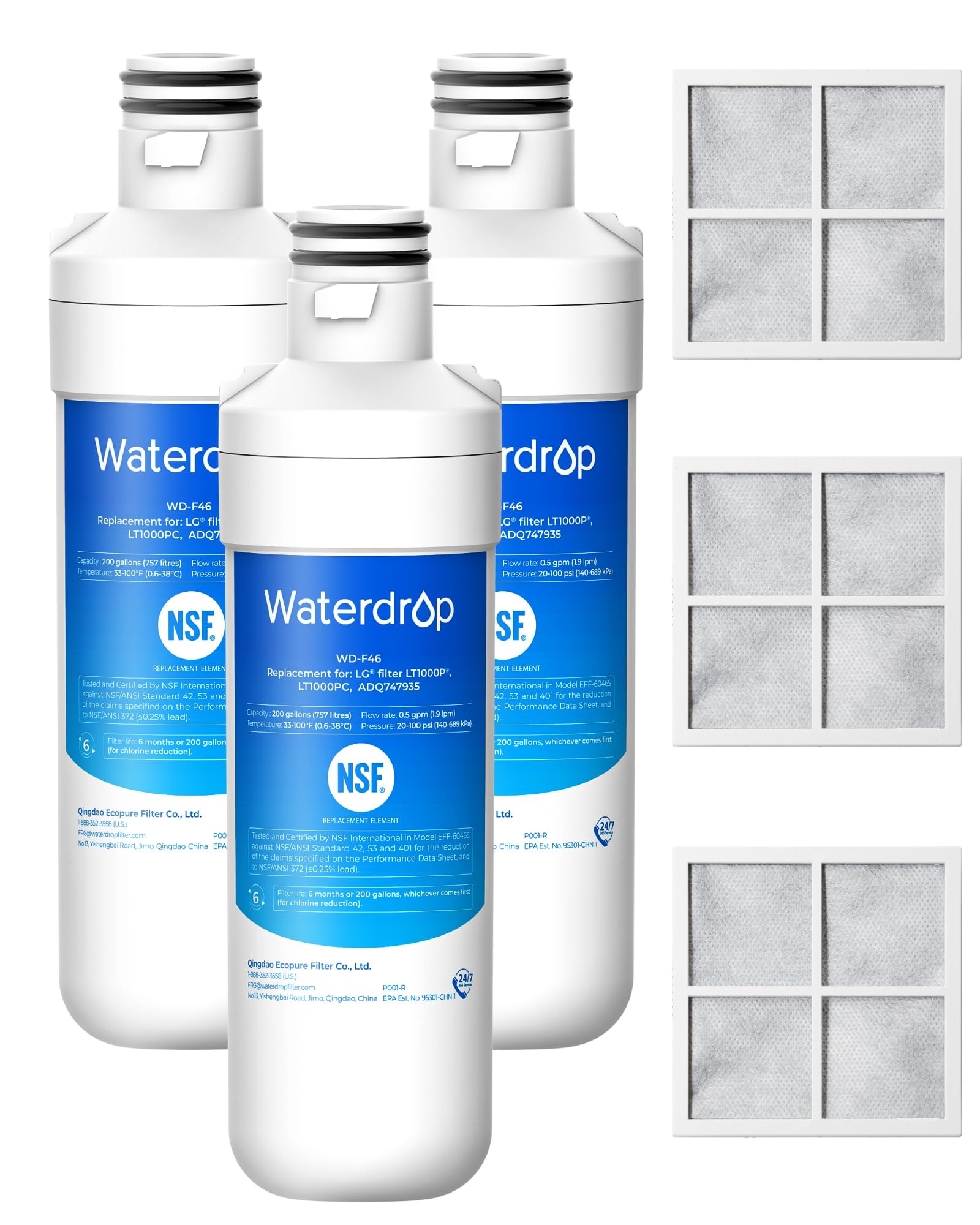
A refrigerator cartridge certified to NSF 42, 53, and 401 covers taste, health contaminants, and emerging contaminants at once, but only if you replace it on schedule.
The Bottom Line
The best home drinking water filtration setup is not a single product. It is a decision made in this order: test your water, pick the point of use, match NSF certifications to your actual contaminants, and budget for cartridges and maintenance. For most households on safe municipal water, a well-certified countertop dispenser or refrigerator filter covers taste, lead, and microplastics affordably. For cyst risk on a well, the CDC's wording points to RO or an NSF 53 absolute-1-micron filter. For whole-home issues, stage a system to the specific problem rather than buying the biggest box.
When you are ready to look at specific products, our research-based deep dives into a large-capacity filtered dispenser and a popular LG-compatible refrigerator cartridge show how these certification rules play out on real, in-stock options.
Related Posts


Buying Guides — Best Back to School Dorm Essentials 2026: 6 Research-Backed Picks
Skip the 75-item packing list. These six research-backed dorm essentials solve the problems every residence-hall student actually hits, from communal bathrooms to outlet shortages, all verified at July 2026 deal prices.