How to Choose a Rechargeable Headlamp: A Complete Buyer's Guide
 Abdulwahab Suleiman·August 1, 2026
Start With How You'll Actually Use It, Not the Lumen Number
Most headlamp regret starts the same way: someone buys the brightest model on the shelf, then discovers it is heavy, eats through a charge in ninety minutes on high, and blinds everyone across the campsite. Learning how to choose a rechargeable headlamp is less about chasing a spec-sheet trophy and more about matching a light to the job in front of you. A plumber crawling under a sink, a trail runner logging pre-dawn miles, and a backpacker reading in a tent all want very different things from the same category of product.
So before you compare a single number, answer one question: what will this headlamp spend most of its life doing? Close-up work at arm's length needs a wide, even flood and modest output. Moving fast over uneven ground needs reach and a tighter beam. Emergency-kit duty needs a light that holds a charge for months and turns on the first time, every time. Everything below hangs off that decision.
Rechargeable models add one more wrinkle worth naming up front. A built-in or USB-charged battery is convenient and cheaper to run than a drawer full of AAAs, but it also ties the light's usable life to how you manage power. That trade-off runs through brightness, runtime, and battery type, so we will keep coming back to it.
If you want the short version of the brightness question before we go deep, our companion explainer on how many lumens you actually need for a headlamp breaks the tiers down by activity. This guide is the wider decision: the six specs that actually separate a headlamp you keep from one you return.
How Much Brightness Do You Really Need?
Lumens measure total light output, and they are the number marketing leans on hardest. They are also the number buyers most often over-read. Under the ANSI/PLATO FL1 standard, the lumen figure on the box is measured in an integrating sphere at the moment the light turns on, before the battery sags. It is a real, comparable number when a brand publishes it to that standard, but it describes a peak, not the light you live with.
Here is the part the packaging rarely says out loud: brightness has sharp diminishing returns. For close work and camp chores, 100 to 200 lumens is plenty and often more pleasant, because a wall of light bouncing off your hands, fog, or nearby foliage destroys the dark-adapted vision you actually navigate by. For hiking and general outdoor use, roughly 200 to 400 lumens covers the vast majority of situations. Reaching for 500-plus lumens makes sense mainly when you need to throw light a long way, such as spotting trail markers on an alpine route or scanning a work site.
A useful way to think about it: buy the max output you occasionally need, but plan to spend most of your time on a middle setting. A 400-lumen light run at 150 lumens will feel bright, last far longer, and stay comfortable. That is why runtime charts matter more than the headline number, a point we will return to below.
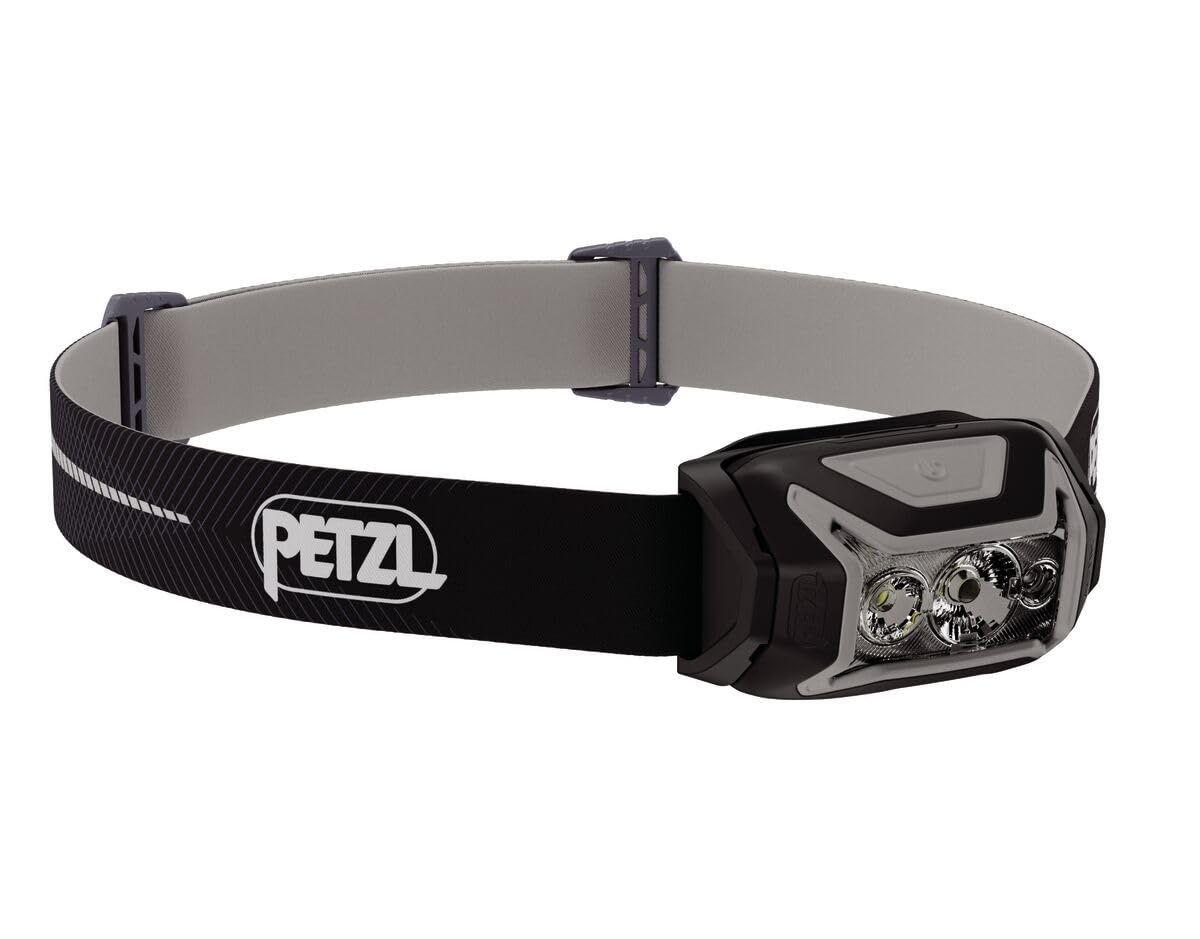
The Petzl Actik Core lists 625 lumens but earns its keep on its lower, longer-lasting settings.
Take a mid-tier all-rounder as an anchor. The Petzl Actik Core is rated at 625 lumens with three white levels tuned for max burn time, a power-and-runtime balance, and max power, per Petzl's official spec page. That tiered layout is the tell of a well-designed light: it assumes you will not sit on max, and gives you sensible steps down to stretch the charge.
Beam Type and Beam Distance: Flood, Spot, and Mixed
Two headlamps with identical lumen ratings can perform completely differently because of how they shape the light. This is the spec buyers most often ignore and most often notice in the field.
- Flood (wide) beam: a broad, even wash of light for close-range tasks, cooking, reading, tent work, and repairs. It lights up your whole field of view but does not reach far.
- Spot (focused) beam: a tighter, brighter column that throws light down the trail or across a work area. Great for distance, less pleasant for anything right in front of you.
- Mixed beam: many quality headlamps combine both, or let you switch, so one light covers camp chores and the walk to the ridge.
Beam distance is the companion number, and the FL1 standard defines it precisely: it is the distance at which the light delivers illuminance equivalent to a full moon on a clear night, about 0.25 lux, as described in the ANSI/PLATO FL1 documentation. That is enough to make out shapes, not to read fine print. So a headlamp rated for 115 meters of beam distance, like the Actik Core's published figure, gives you usable orientation to roughly that range, not brilliant illumination the whole way.
Match beam to terrain. Established trails and campsites reward a wide, even beam. Off-trail travel, running, and route-finding reward reach. If you only buy one, a mixed-beam headlamp is the safe default because it flexes both ways.
Runtime, Regulation, and What "All-Day" Actually Means
Runtime is where honest brands and optimistic ones part company, and it is the spec most worth reading carefully on a rechargeable light. Under FL1, runtime is measured until output falls to 10 percent of the initial value. That means a headlamp can technically be "running" while emitting a fraction of its rated brightness. Two questions cut through the marketing:
- What is the runtime at each brightness level? A single big number is nearly useless. You want the curve: high, medium, and low, so you can plan around how you actually use it.
- Is the output regulated or does it fade? Some lights hold a steady brightness for most of the charge, then drop off. Others dim gradually from the first minute. Regulated output is more predictable but can shut off with little warning, so a low-battery indicator becomes valuable.
Work lights are a clean illustration because they publish honest mode-by-mode figures. The Klein Tools 56064 is rated at 400 lumens for about four hours on boost, 200 lumens for roughly twelve hours on spotlight, and 100 lumens for about twenty-two hours on flood, according to Klein's product page. Notice the pattern: cut the brightness roughly in half and runtime more than doubles. That relationship is the single most useful thing to internalize when you learn how to choose a rechargeable headlamp.
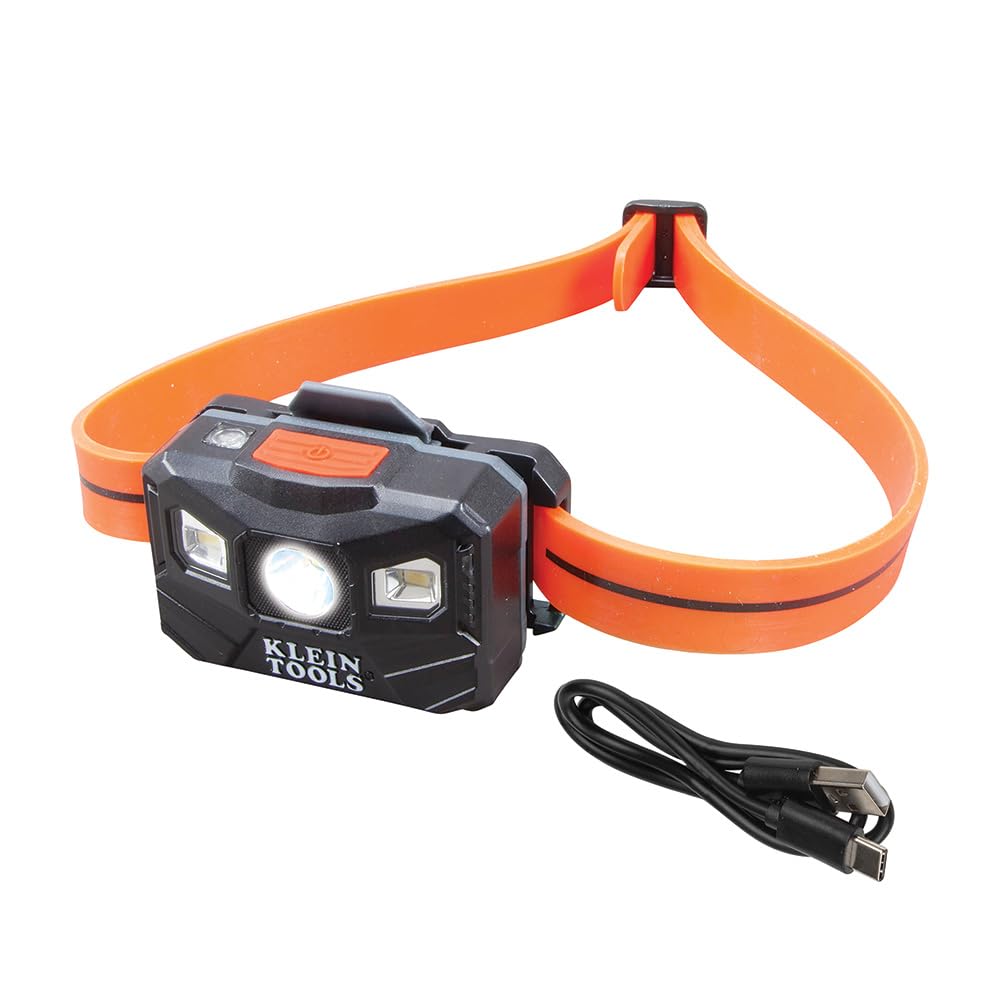
The Klein 56064 publishes mode-by-mode runtimes, from about four hours on boost to roughly twenty-two on flood.
For a rechargeable light specifically, also weigh recharge speed and top-up habits. Some worklights hit 50 percent charge in about half an hour, which matters when you charge on a lunch break rather than overnight. And because there is no drawer of spare AAAs to fall back on, a fast, convenient charge is part of the light's real-world reliability, not a nice-to-have.
Battery Type: Built-In, Swappable, and the USB-C Question
"Rechargeable" hides three meaningfully different designs, and picking the wrong one for your use is the most common expensive mistake.
Sealed built-in battery. The pack lives inside the light and charges by cable. These are simple, often lighter, and usually the most weather-sealed because there is no removable door. The catch: when the battery is drained you must stop and charge, and years later a worn cell can be hard or impossible to replace. Best for day users who can top up regularly.
Proprietary rechargeable pack (with backup). Some outdoor headlamps use a branded rechargeable core that also accepts standard disposable cells in a pinch. The Petzl Actik Core's hybrid design is the textbook case: it ships with a 1250 mAh rechargeable CORE battery but also runs on three AAA cells, per Petzl's specifications. For backpacking and travel, that fallback is genuinely reassuring, because you can buy AAAs anywhere on earth.
Swappable 18650 or 21700 cells. Higher-output models often use a removable lithium-ion cell you can charge in the light by USB-C or swap for a fresh one. This is the most flexible option for long nights and high-drain use, since carrying a spare cell effectively doubles your runtime. It also means more to manage and a higher up-front cost.
On charging ports, favor USB-C over older micro-USB. It is reversible, faster, and increasingly the only cable you carry. A few things to verify before buying: whether the light charges in place or requires removing the battery, whether it can run while plugged into a power bank, and whether it reports charge state with a gauge. A battery gauge is easy to overlook and easy to miss once you have owned one. The Klein 56064, for instance, uses colored LEDs to show remaining charge, which turns "am I about to be in the dark?" from a guess into a glance.
For a deeper look at how output and battery capacity interact across real models, our roundup of the best rechargeable headlamps for work and outdoor use compares these battery designs side by side.
Waterproofing and Durability: Reading IP Ratings Correctly
An IP rating (Ingress Protection) tells you how well a device resists solids and liquids, and it is defined by the international IEC 60529 standard. The format is two digits: the first is dust resistance, the second is water resistance. When you see an X, that dimension simply was not rated, not that it failed.
For headlamps, the water digit is what you will compare most often. Petzl's own explainer lays out what the common tiers survive:
- IPX4: protected against splashing and rain from any direction. This covers most hiking, running, and camping in weather.
- IPX7: can be submerged in up to one meter of water for thirty minutes.
- IP67: fully dust-tight and submersible to one meter for thirty minutes.
Petzl's watertightness page is worth reading if you want the precise conditions, because the ratings describe a controlled test, not a promise about every real-world dunk. The practical takeaway: IPX4 is the sensible floor for outdoor use, and you only need IPX7 or IP67 if you expect real submersion, such as paddling, caving, or heavy storm work.
Note that a full IP rating (two digits) also certifies dust resistance, which matters more on a job site than a trail. The Milwaukee 2111-21 hard-hat headlamp carries an IP54 rating, meaning meaningful dust protection plus splash resistance, per Milwaukee's product page. That is a deliberate work-first choice: the first digit is doing real work in an environment full of drywall dust and sawdust.
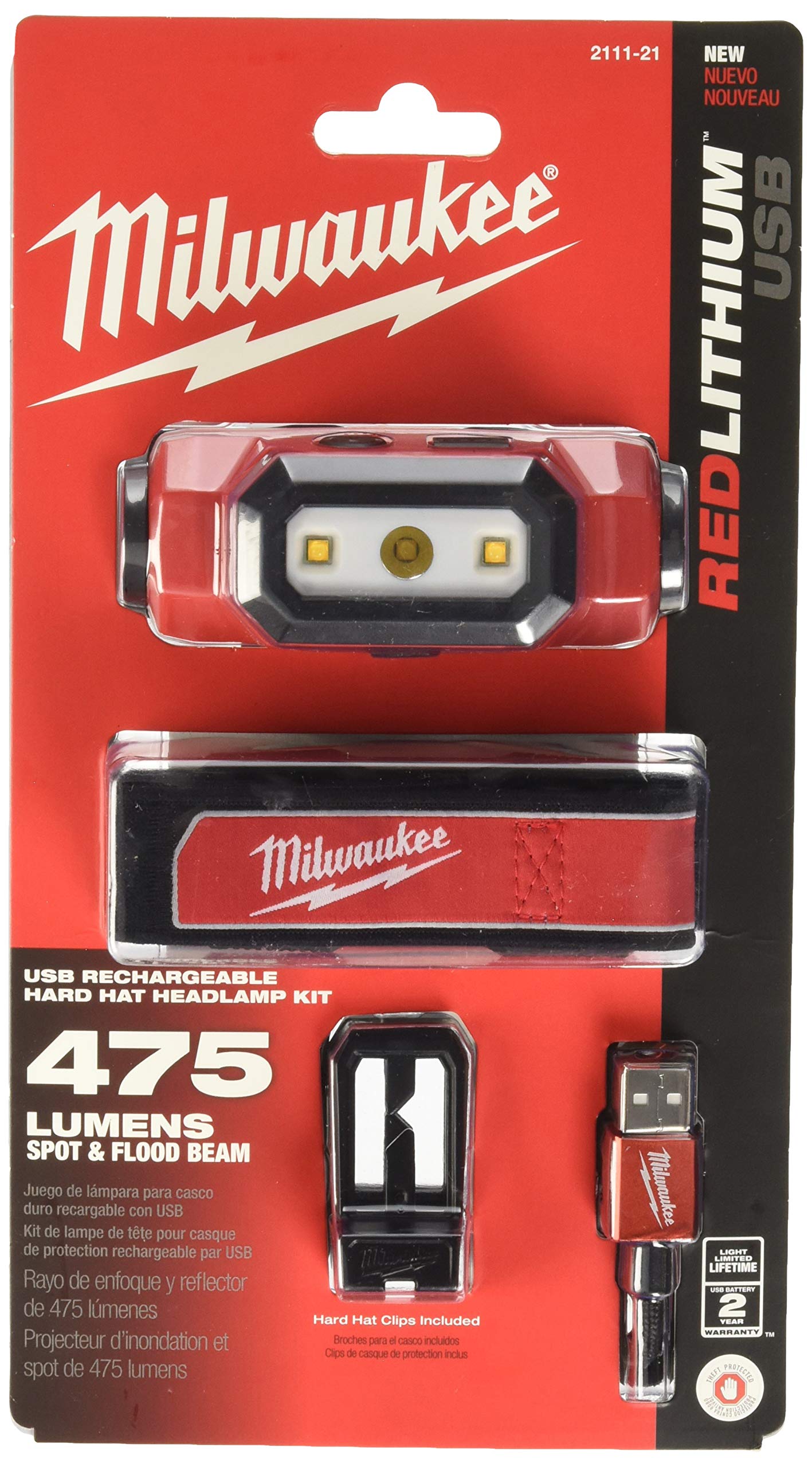
The Milwaukee 2111-21 carries an IP54 rating, prioritizing dust resistance for job-site conditions.
Beyond water and dust, look for a stated drop or impact rating if the light will get knocked around. The Klein 56064, for example, publishes a six-foot drop rating, which is the kind of spec that separates a tool from a toy. Housing material matters too: a quality polymer or aluminum body will outlast a thin plastic shell, and a secure battery door is what keeps that IP rating honest after a year of use.
Comfort, Weight, and Fit
This is the spec no chart shows and every long night reveals. A headlamp you forget you are wearing gets used; one that bounces, pinches, or slides gets left at home. Three things drive comfort.
Weight and balance. Lightweight outdoor models often land under 100 grams, and the Actik Core's roughly 88-gram weight is typical of that class. Higher-output lights with big cells weigh more, and some move the battery to the back of the strap to balance the load against your forehead. For running or all-day wear, lighter and balanced wins. For stationary work, weight matters less.
Strap design. A simple elastic band is fine for light use. A top strap over the crown helps stabilize heavier lights and keeps them from creeping down during activity. If you wear a hard hat or helmet, check for clips or a compatible mount rather than assuming the strap will cooperate; work-oriented lights like the Milwaukee and Klein models are explicitly designed to attach to a hard hat.
Tilt and adjustability. The ability to angle the beam down toward your hands or a trail is basic but essential, and cheap hinges wear out or slip. A ratcheting tilt that holds its position is a small quality signal worth checking.
Fit is personal, so where you can, prioritize a model with a proven comfortable design over one that simply wins on paper. A 1000-lumen light you never reach for is worse than a 300-lumen light you always have on your head.
Extra Features Worth Paying For (and a Few That Aren't)
Once the fundamentals fit your use, a handful of features earn their place:
- Red light mode. A red LED preserves dark-adapted vision far better than white light and does not blind companions. Research on scotopic vision explains why: the eye's rod cells are least sensitive to long-wavelength red light, so a dim red beam lets your night vision recover while you still see close up. It is genuinely useful for astronomy, camping, and anyone sharing a tent. Many quality lights, the Actik Core included, offer a dedicated continuous red mode.
- Lockout mode. A way to disable the button so the light cannot switch on inside a pack and drain itself. On a sealed rechargeable, an accidental drain can leave you dark with no spare battery to swap, so lockout is more valuable here than on a AAA light.
- Battery gauge or low-battery warning. Covered above, but worth repeating: on a rechargeable, knowing your remaining charge is the difference between a planned top-up and a dead light.
- Regulated brightness with sensible modes. A light that remembers your last setting, or starts on low instead of blasting max, is a small daily kindness.
- Auto-off and sensing. Some worklights, like the Klein 56064, automatically shut off after a few minutes in bright ambient light to save charge. Handy on a job site, less relevant on a trail.
Features to weigh more skeptically: extreme "turbo" modes you can only sustain for a minute or two, app connectivity you will never open, and strobe settings marketed as safety tools. None are dealbreakers, but do not let them drive the purchase.
A Quick Framework: Match the Headlamp to the Activity
Pulling it together, here is a decision shortcut once you know your primary use:
- Trail running and fast hiking: prioritize low weight, a mixed or spot beam for reach, regulated output, and a comfortable balanced strap. Brightness in the 300 to 500 lumen range is usually plenty.
- Backpacking and camping: prioritize a wide beam, red mode, long low-setting runtime, and a battery with a disposable backup option. Weight still matters. The Actik Core's hybrid battery is a strong fit here.
- Work and job site: prioritize a full IP rating (dust plus water), a drop rating, hard-hat compatibility, honest mode runtimes, and fast recharge. The Klein 56064 and Milwaukee 2111-21 are built around exactly these priorities.
- Emergency and everyday carry: prioritize a light that holds charge for months, turns on reliably, has lockout, and is simple to operate one-handed in the dark.
- High-output specialty use (search, caving, night work): prioritize swappable 18650/21700 cells so you can carry spares, plus real thermal management so the light does not throttle instantly.
If two models tie on paper, let comfort and battery strategy break the tie. Those are the two variables you will feel every single time you use it.
Common Mistakes to Avoid
A few patterns show up again and again when people are unhappy with a headlamp:
- Buying on peak lumens alone. The headline number is a peak in an integrating sphere, not the light you get an hour in. Read the runtime curve instead.
- Ignoring beam shape. A powerful spot beam is miserable for close work; a pure flood cannot reach down the trail. Know which one your activity needs.
- Overlooking the battery strategy. A sealed rechargeable with no backup is fine for a commuter and risky for a remote backpacker. Match the battery design to how far you get from a charger.
- Skipping the IP rating. An unrated light in a wet or dusty environment is a short-lived light. Treat IPX4 as the outdoor floor and read the two-digit rating for work.
- Choosing on spec, not fit. The most capable headlamp is the one you actually wear. Comfort is not a soft factor; it is the factor that determines whether the rest of the specs ever matter.
Get those five right and you will avoid nearly every headlamp regret. The rest is matching the details to your terrain, your schedule, and your hands.
How We Researched This Guide
Zuqqis builds buying advice from three independent evidence layers, cross-checked against each other rather than any single source. First, we anchor every performance claim on the manufacturer's own published specifications, because the brand's spec sheet is the primary-source record of rated lumens, beam distance, runtime, and IP rating. Second, we hold those numbers to a common measurement standard, the ANSI/PLATO FL1 protocol, so figures from different brands are actually comparable and we can flag when a claim is a peak rather than a sustained value. Third, we corroborate with reputable third-party editorial and standards documentation, including Petzl's technical explainer on IP ratings, to make sure the practical guidance matches how these ratings and standards are defined.
Where a claim can only be traced to unverifiable chatter, we leave it out. That discipline is why this guide talks in terms of standards, published runtimes, and rated protection rather than hype. The goal is a framework you can apply to any model you find, not a nudge toward one product. When you are ready to compare specific options against these criteria, start with our best rechargeable headlamps roundup and the detailed how many lumens do you need breakdown.
Related Posts