
The short answer: how many lumens you actually need
If you want one number to shop by, most people are well served by a headlamp that can reach 200 to 400 lumens on its brightest setting. That range covers walking a dog after dark, setting up camp, reading in a tent, hiking a marked trail, and the vast majority of household and garage jobs. You almost never run a headlamp at full blast for long, so a lamp that can hit 400 lumens but spends most of its life at 40 to 100 is the sweet spot for comfort, runtime, and battery weight.
The honest, slightly annoying truth is that "how many lumens do you need for a headlamp" is the wrong question to stop at. Lumens tell you how much light a lamp pumps out in total, but they say nothing about how far that light throws, how evenly it spreads, or how long the lamp can hold that brightness before the battery sags. Two headlamps rated at the same lumens can feel completely different on your head. So the better question is: what are you doing with it, and how do lumens interact with beam distance and battery life to get you there?
Here is a quick map to anchor the rest of this guide. Treat these as brightness ceilings you occasionally reach, not the level you'll live at.
Use case | Practical lumen range | Why
Reading, tent tasks, close-up work | 5 to 40 lumens | Anything brighter reflects back off pages and gear
Around camp, chores, dog walks | 40 to 150 lumens | Enough to see the ground and your hands
Hiking a marked trail | 150 to 350 lumens | Reads the trail a few steps ahead at walking pace
Trail running, fast night travel | 300 to 600 lumens | You need to see farther because you're moving faster
Route-finding, mountaineering, search | 600 to 1,000+ lumens | Throwing a beam far into open terrain
Jobsite and mechanical work | 200 to 500 lumens, flood-heavy | Even, close, glare-free light on the task
The rest of this guide explains where those numbers come from, why a "1,400-lumen" headlamp isn't 3.5 times more useful than a 400-lumen one, and how to avoid buying more brightness than you can actually use.
How we researched this guide
Our confidence in these numbers comes from cross-checking three independent layers of evidence. First, we anchor every technical claim to manufacturer specifications published under the ANSI/PLATO FL1 standard, which forces brands to report lumens, beam distance, and runtime the same way. Second, we weigh those numbers against independent editorial testing outlets that measure beams on an optical bench, so marketing claims meet real-world scrutiny. Third, we ground the underlying physics in the published lighting standard itself. When all three agree, we report it plainly. When they disagree, we say so and explain why. That is the standard behind every number below.
What "lumens" actually measure (and what they don't)
Lumens, lux, and candela are three different things
A lumen is a measure of total light output. Picture a bare bulb glowing in every direction: add up all that light and you get lumens. That's genuinely useful for rating a room's worth of illumination, but it's a blunt instrument for a headlamp, where you care about a specific patch of trail or workpiece.
The gear-testing outlet OutdoorGearLab puts the problem bluntly: lumens are "a measure of light energy in any direction," which is "a good way to spec a lightbulb but is often misleading for estimating the quality of a focused beam" (OutdoorGearLab, Best Headlamp). In other words, a lamp can post a big lumen number and still throw a mushy, useless beam if its reflector and lens are poorly designed.
Two other units matter more than most shoppers realize:
- Lux measures how much light actually lands on a surface. It's lumens spread over an area, so it tells you how bright the ground looks under your feet. A tightly focused 200-lumen beam can deliver more lux on a distant object than a floody 500-lumen beam.
- Candela measures the intensity of the brightest point in the beam. This is the number that governs how far a headlamp can throw light, and it's the reason two lamps with identical lumens can have wildly different reach.
Beam distance is a candela story, not a lumen story
Under the ANSI/PLATO FL1 standard, beam distance isn't a marketing guess. It's calculated from candela. The standard defines the rated distance as the point at which the light falling on a surface drops to 0.25 lux, which works out to the square root of the peak beam intensity in candela divided by 0.25 (ANSI FL1 standard, via Wikipedia). For context, 0.25 lux is roughly the brightness of a scene lit by a full moon, so "beam distance" really means "the farthest point where you can just make things out."
The practical takeaway: if you want to see far, you're shopping for candela and a focused optic, not raw lumens. A headlamp with a spot-heavy reflector and modest lumens can out-throw a floody lamp with a much bigger lumen rating. This is why the same testing outlet noted that some lights with impressive beam distance still earned "relatively poor marks for Trail Finding" (OutdoorGearLab): reach without a usable spread of light around it is hard to walk under.
Max lumens versus sustained (regulated) output
Here's the number brands print in the biggest font and the number you'll actually live with, and they're rarely the same. The FL1 standard measures light output 30 seconds after switch-on with a fresh charge (ANSI FL1 standard). That "turbo" figure is real, but many lamps can only hold it for a minute or two before heat and battery drain force a step-down.
Better headlamps use regulated (or "constant") output, holding a steady brightness for most of the battery's life instead of fading gradually. Regulation is why a well-designed lamp can advertise a huge peak while still being pleasant to use: it settles into a sustainable level and stays there. When you compare two lamps, look past the headline lumen count and ask how long each holds a useful brightness. Runtime under FL1 is measured until the beam falls to 10 percent of its 30-second value (ANSI FL1 standard), so a lamp that "runs 100 hours" may spend most of that time dimmer than you'd like unless it's regulated.
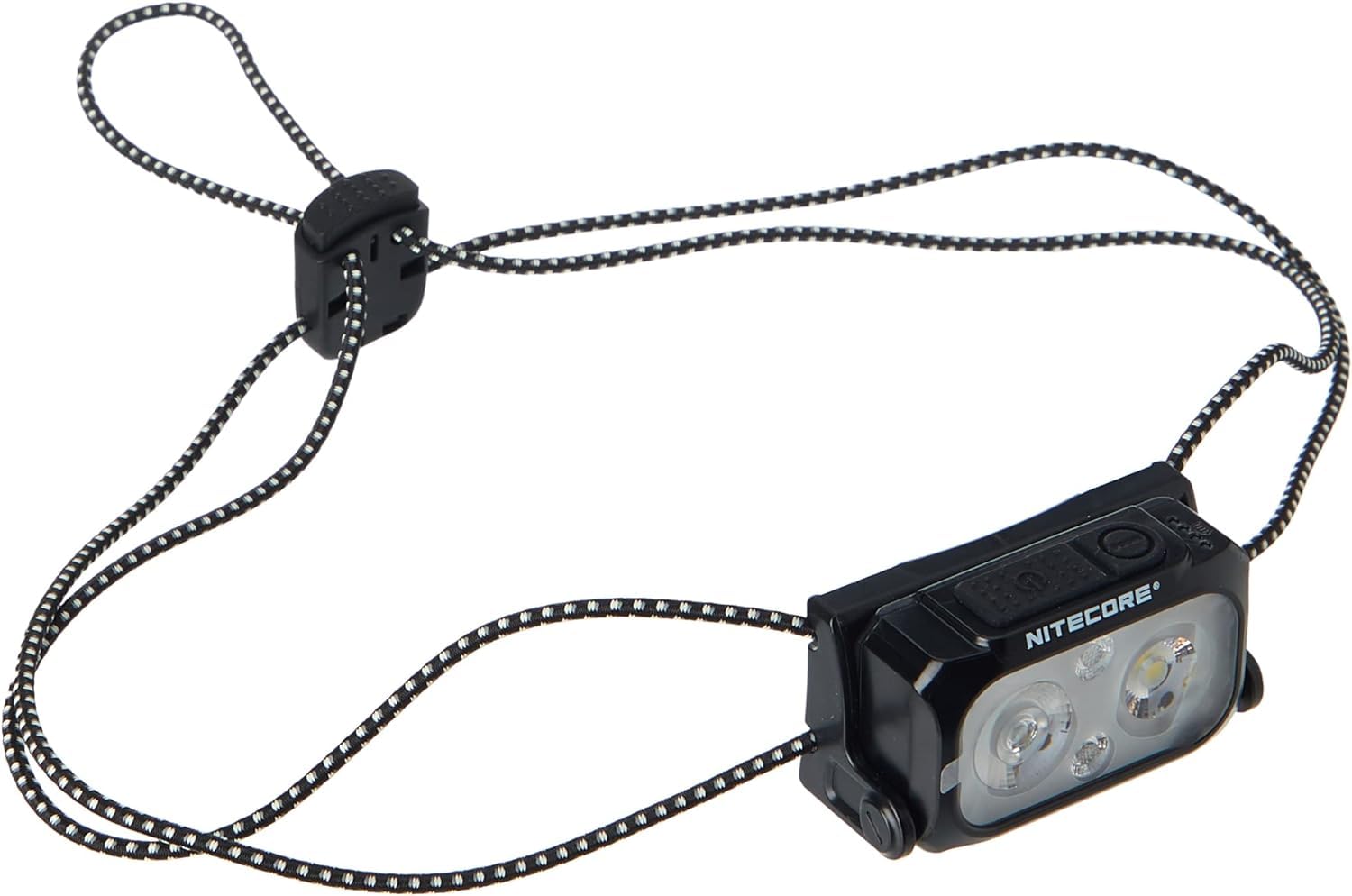
Ultralight lamps like the 400-lumen Nitecore NU25 rarely run at full output; you live in the lower modes.
How many lumens by activity
Brightness needs scale with how fast you move and how far ahead you need to see. Walk slowly and your eyes only need the next couple of steps lit. Run, ski, or ride and you need to see much farther to react in time. Here's how the lumen ranges break down.
Everyday carry and household use: 20 to 150 lumens
Before the outdoor extremes, it's worth naming the use most people actually buy for: power outages, checking the attic, walking the dog, changing a tire, and finding the fuse box. For this everyday tier, a lamp that peaks around 150 lumens and idles near 20 is more than enough, and the low modes matter far more than the high one. What you want here is instant, reliable turn-on, a comfortable strap, and enough runtime to forget you're wearing it. A 400-lumen ceiling is a nice bonus for the moment a raccoon rustles in the yard, but you'll spend almost all your household time in double digits. Don't overpay in lumens for a lamp that lives in a kitchen drawer.
Around camp, reading, and close-up tasks: 5 to 40 lumens
This is the setting most people underestimate. For pitching a tent, cooking, reading, digging through a pack, or fixing something at arm's length, you want less light than you think. Anything above roughly 40 lumens starts bouncing back off the page, the map, the inside of the tent, or the shiny part you're working on, which wrecks your night-adjusted vision. Many quality headlamps offer a dedicated low mode in the single digits precisely for this. A red-light mode, common on hiking-oriented lamps, preserves night vision even better and keeps you from blinding tentmates.
Hiking a marked trail: 150 to 350 lumens
At walking pace on a defined trail, 150 to 350 lumens is plenty. You're reading the ground a few steps ahead and picking out roots, rocks, and blazes, not lighting up the whole valley. A great illustration is the Petzl Actik Core: its manufacturer specs list 625 lumens on max, but its "Standard" mode delivers a balanced 60-meter beam that runs for about 7 hours, while the top setting throws 115 meters for roughly 2 hours (Petzl Actik Core specifications). Notice the pattern: you buy the higher ceiling for the option of reach, but you hike in the efficient middle. OutdoorGearLab even lists 150-lumen lamps as capable general backpacking choices, which underlines how little you need at a walk (OutdoorGearLab).
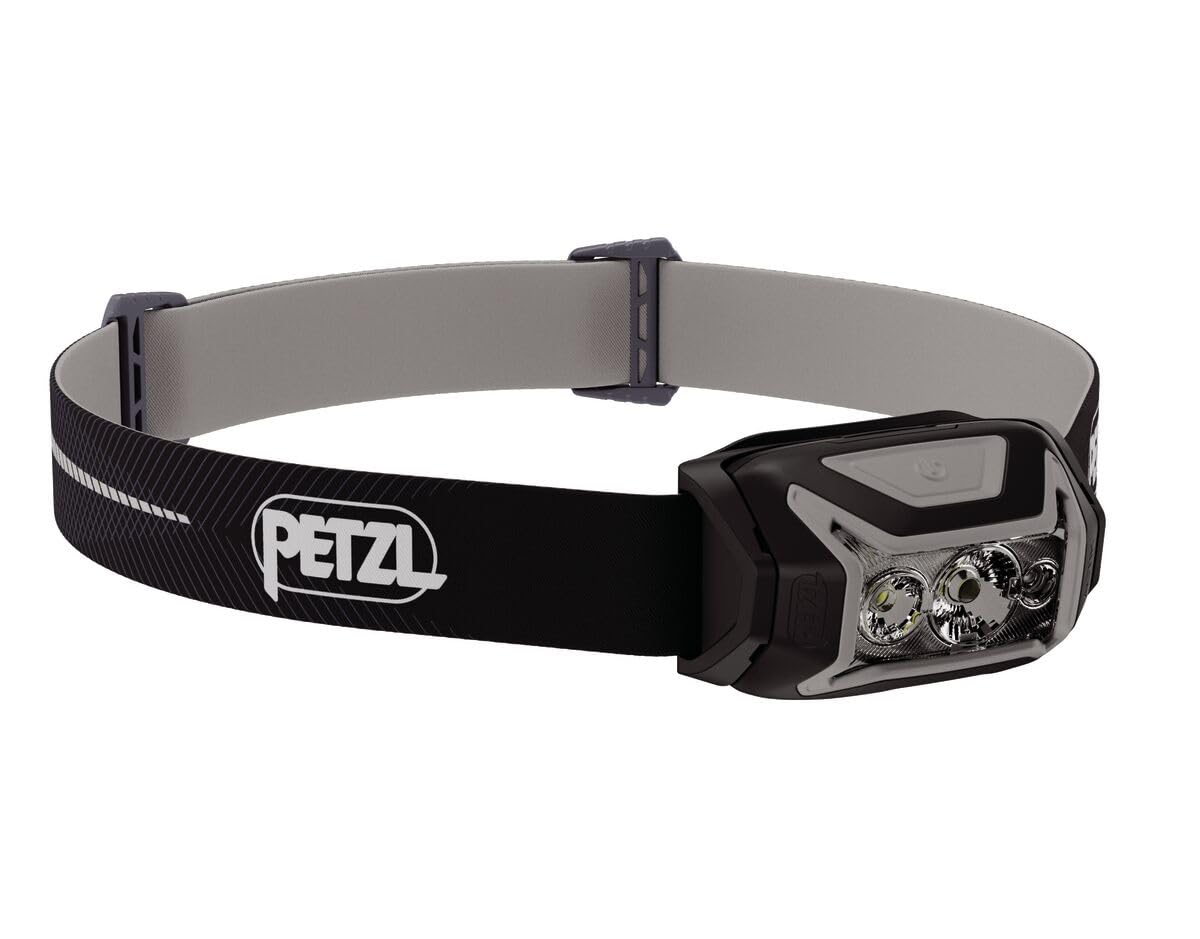
The Petzl Actik Core tops out at 625 lumens but is designed to hike in a 60-meter standard mode for far longer runtime.
Trail running and fast night travel: 300 to 600 lumens
Move faster and physics catches up with you. A runner covering ground at speed needs to see far enough ahead to plant a foot safely, which pushes the useful range up toward 300 to 600 lumens with a beam that mixes flood (to light the immediate ground) and spot (to reveal what's coming). This is also where beam quality separates good lamps from bright ones. A lamp that's all spot leaves you tunnel-visioned; a lamp that's all flood leaves you unable to see the next turn. Bounce control matters too, so runners lean toward lighter lamps or rear-battery designs that stay put.
Route-finding, mountaineering, and search: 600 to 1,000+ lumens
Off-trail travel, glacier route-finding, alpine starts, and searching open terrain are the genuine homes of the high-lumen headlamp. When there's no trail to follow and you're scanning a slope or a scree field a hundred meters out, candela and lumens both climb. This is the scenario that justifies a lamp like the Black Diamond Spot 400-R reaching for its top output, or a heavy hitter like the Fenix HM65R and its 1,400-lumen ceiling. But even here, you'll use the peak in bursts to scan ahead, then drop back down to conserve battery. Nobody skins up a mountain on turbo the whole way.
How many lumens for work and the jobsite
Work lighting flips the priorities. On a trail you care about throw; at a workbench, in a crawlspace, or under a car you care about a wide, even, glare-free pool of light close to your hands. That's a flood problem, not a distance problem, so a 300-lumen jobsite lamp with a broad, warm-tinted beam often beats a 700-lumen hiking lamp with a tight spot.
A few work-specific factors:
- Lux at the surface beats headline lumens. You're lighting something two feet away, so you want light concentrated on the task without hotspots that cast hard shadows. Flood optics spread the lumens usefully.
- Runtime has to survive a shift. A tradesperson can't recharge mid-job. Look for regulated output and a battery that holds a working brightness for the length of the work, not a turbo figure that lasts ninety seconds.
- Glare and reflection are the enemy. Shiny metal, glossy paint, and white drywall throw light back at you. Overly bright work lamps are genuinely counterproductive indoors.
For most home and professional work, a headlamp that peaks around 300 to 500 lumens with a strong flood mode and all-day regulated runtime is ideal. If you want help weighing beam type, battery format, and durability for a specific trade, our companion guide on how to choose a rechargeable headlamp walks through the tradeoffs in detail.
Can a headlamp be too bright?
Yes, and it's a more common mistake than buying too little. Excess brightness causes three real problems.
Backscatter and reflection. In fog, rain, snow, or dust, a very bright beam lights up the particles in the air between you and the ground, creating a wall of glare that actually reduces how well you see. The same happens with reflective trail markers, snow, and light-colored rock. Dialing brightness down often reveals more than cranking it up.
Blinding the people around you. Look at a companion with a 1,000-lumen lamp on high and you've just wrecked their night vision for several minutes. This is why serious hiking lamps include a red mode and easy dimming, and why trail etiquette leans toward the lowest setting that does the job.
Wasted battery and weight. Every extra lumen you rarely use still cost you battery capacity, and therefore grams on your forehead. OutdoorGearLab found that the brightest lamps "suffered from shorter battery life in their high output mode," with even a strong regulated performer holding its 1,400-lumen turbo for only a few hours (OutdoorGearLab). Brightness you can't sustain isn't brightness you can plan around.
The fix isn't to buy a dim lamp. It's to buy a lamp with a wide range of well-spaced modes and to spend most of your time in the lower ones. A good headlamp gives you a whisper-quiet 5-lumen mode for the tent and a 400-lumen punch for the moment you hear something in the dark, all in the same unit.
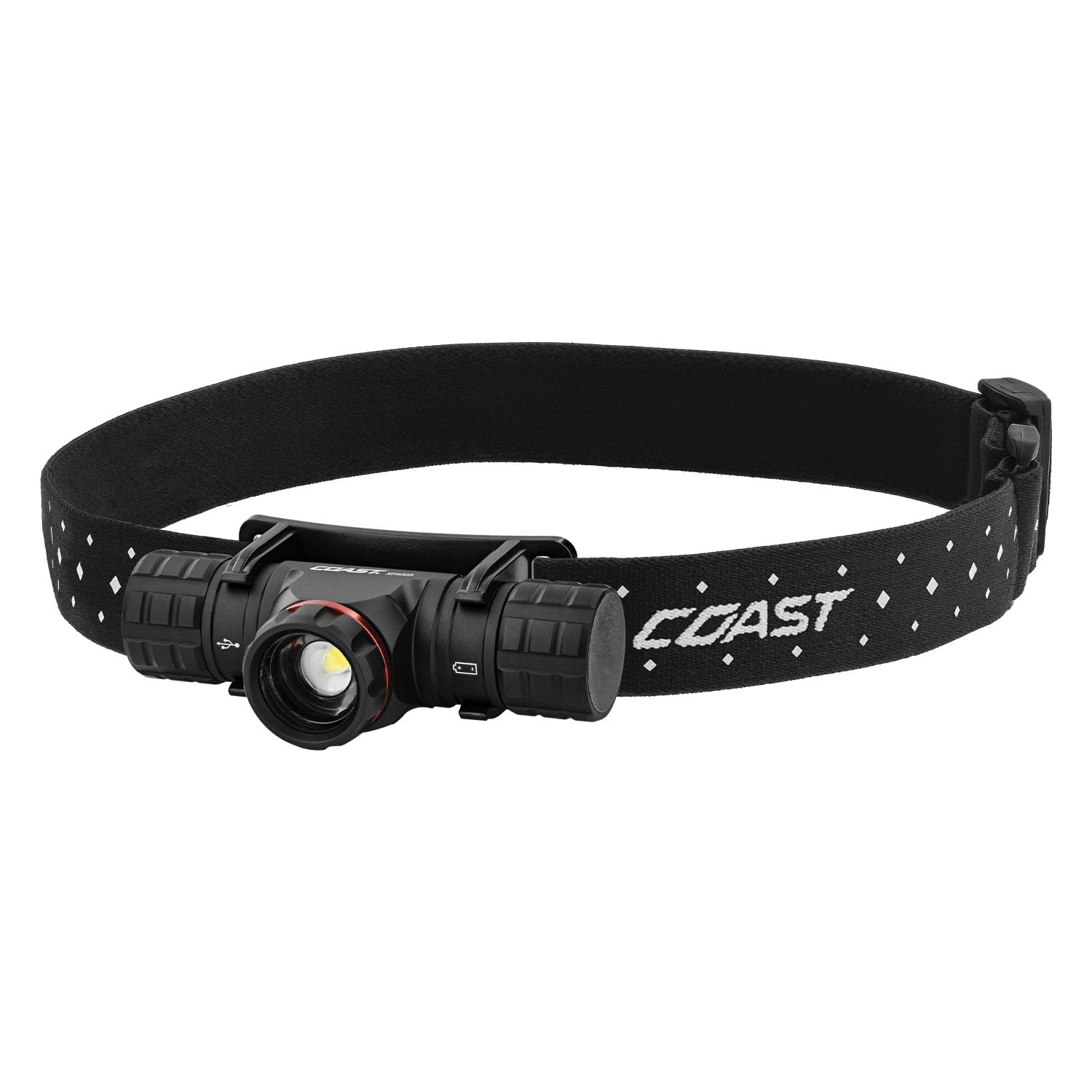
High-output lamps like the 1,200-lumen Coast XPH30R shine for scanning open terrain, but you dim them for everything close.
Lumens vs. beam distance vs. battery life: the triangle
Every headlamp is a negotiation between three things: how bright it gets, how far it throws, and how long it lasts. Push any one up and, all else equal, you pay somewhere else.
- More lumens, shorter runtime. Driving the LED harder burns the battery faster. That's why turbo modes are rated in minutes and low modes in dozens of hours.
- More throw, narrower beam. Focusing candela into a tight spot for distance means less light spread around you for peripheral awareness. Great for scanning, poor for close footing.
- Longer runtime, bigger battery. More capacity means more weight, or a bulkier rear-mounted pack.
Two features soften the tradeoff. Regulated output keeps brightness flat across the discharge curve instead of letting it fade, so the battery you have works harder for you. And dual-power or USB-C rechargeable designs let you top up from a power bank or drop in disposable cells when you're far from an outlet, which effectively extends runtime without adding a huge onboard battery. When you compare lamps, weigh the whole triangle. A 400-lumen lamp with clean regulation and a 60-hour low mode is often more useful in the field than a 1,000-lumen lamp that dumps its charge in a couple of hours.
For a side-by-side comparison of how specific models balance this triangle across work and outdoor use, see our roundup of the best rechargeable headlamps for work and outdoor.
Don't forget water resistance and beam tint
Two specs quietly shape whether a headlamp is right for your lumen budget.
IPX rating. The FL1 standard reports water resistance on the IP scale: IPX4 means splash-resistant from any direction, IPX7 means it survives brief immersion, and IPX8 means submersion beyond a meter for 30 minutes or more (ANSI FL1 standard). For rain and sweat, IPX4 (the Petzl Actik Core's rating, for instance) is fine; for paddling, fishing, or heavy storms, step up to IPX7 or better.
Beam tint. Cooler white LEDs often post slightly higher lumen numbers, but a neutral or warmer tint renders terrain, color, and contrast better, which can make a 300-lumen warm beam feel more usable than a 400-lumen icy-blue one. Tint isn't in the lumen spec, so judge it from independent beam-shots rather than the number on the box.
A simple lumen recommendation you can trust
If you strip away the jargon, the buying logic is short:
- Pick your fastest activity. Match the lumen ceiling to the most demanding thing you'll do, not the average. Occasional trail running? Aim for a lamp that can reach ~500 lumens even if you usually hike.
- Prioritize a wide mode range over a big top number. A lamp that spans roughly 5 to 400+ lumens with well-spaced steps beats a one-trick 1,000-lumen brute for almost everyone.
- Check sustained runtime, not just turbo. Regulated output and an honest mid-mode runtime tell you what the lamp is actually like to live with.
- Match beam shape to the job. Flood for close work, spot for distance, a blend for running and general trail use.
- Confirm IPX and, if you can, tint. Weatherproofing and beam color decide comfort as much as brightness does.
For most readers, a modern USB-C rechargeable lamp in the 200-to-400-lumen class, with regulated output, a red mode, and IPX4 or better, is the right answer. Runners, alpinists, and searchers should size up toward 500 to 1,000+ lumens and pay close attention to candela and beam distance. Tradespeople should favor a flood-heavy 300-to-500-lumen lamp with shift-long runtime.
The bottom line
How many lumens is a good headlamp? A lamp that can reach 200 to 400 lumens covers most people, most of the time, because you'll spend the majority of your night in the 20-to-100-lumen range and only occasionally reach for the top.
Is 1,000 lumens too much for a headlamp? For camp, dog walks, and marked trails, yes, as a working level. But a high ceiling is fine and even welcome as an option you tap in bursts, as long as the lamp also has genuinely useful low modes and doesn't force you to live on turbo.
Do more lumens always mean a farther beam? No. Beam distance is set by candela and the optic, not by total lumens (ANSI FL1 standard). A focused lamp with modest lumens can out-throw a floody lamp with a bigger number.
What's the single most important thing? Match brightness to how fast you move, then favor a lamp with a wide range of well-regulated modes so you can dial the light to the moment. That flexibility, far more than a record-setting lumen count, is what makes a headlamp feel great in the dark.
Related Posts