
Are Arch Support Sandals Worth It? The Honest Answer
Short version: for most people, yes — but the value depends heavily on your feet, how you'll wear them, and whether the sandal is actually built to support an arch or just marketed that way. A flat slide and a contoured, arch-supporting sandal can look almost identical on a product page, yet they do very different things to your foot over a long day. This article unpacks where the support genuinely earns its keep, where the claims are oversold, and how to tell the difference before you spend.
A quick note on how we put this together. We did not lab-test sandals or measure anyone's gait ourselves. Instead, we synthesized peer-reviewed biomechanics research, podiatrist guidance, garment-and-footwear buying advice, and manufacturers' own published specifications, and we link every factual claim so you can check it. The aim is a clear, honest answer to a question a lot of shoppers ask but rarely get a straight response to.
If you'd rather skip the science and see how all of this maps onto specific pairs, our companion guide to the best women's warm-weather sandals ranks options by what they're actually good for. This piece is the "should I even bother?" half of that decision.
What "Arch Support" Actually Does to Your Foot
To judge whether arch support is worth paying for, it helps to know what it's doing mechanically. Your foot's medial longitudinal arch — the curve along the inside of your foot — acts like a spring. With every step it flattens to absorb load, then recoils to help push you forward. The plantar fascia, a thick band of tissue running from your heel to the ball of your foot, is the main cable holding that arch together.
A flat sandal lets the arch drop fully with each step. That isn't catastrophic for a healthy foot on a short walk, but over hours it means the plantar fascia is repeatedly stretched to its limit, with strain concentrating where it anchors at the heel bone. Supportive footwear changes the math: it distributes pressure more evenly, improves shock absorption, and keeps the foot in better alignment, which reduces the strain the fascia has to absorb, according to podiatrists writing on plantar fasciitis footwear.
The research actually backs this up
This is the part that surprised us, because "arch support" gets thrown around so loosely it sounds like marketing fluff. But there's measured evidence. A 2014 study in the Journal of Foot and Ankle Research used radiographic and anthropometric measurements to test whether a contoured sandal could support the arch. It found that a contoured sandal raised dorsal arch height by roughly 4.3 to 5.1 mm compared to standing barefoot, and concluded that "a contoured sandal, designed with a similar foot bed as a pre-fabricated foot orthosis, can provide the same degree of support to the arch/midfoot region as a pre-fabricated orthosis," per the published study.
That's the crux of the whole question. A genuinely contoured footbed isn't cosmetic — it measurably lifts and supports the arch in a way that approaches what a store-bought orthotic does. So when the sandal is built right, the support is real, not a sticker on the box.
Calcaneal eversion and why the heel cup matters
There's a second mechanism that's easy to overlook: what happens at the heel. When your heel strikes the ground, the calcaneus (heel bone) tends to roll inward — calcaneal eversion. Too much of that roll tugs on the plantar fascia at its insertion, which is exactly where plantar fasciitis pain tends to live. A deep heel cup cradles the heel and limits that inward roll, as podiatrist guidance on sandal design explains. So "arch support" is really shorthand for a system: arch contour plus heel cup plus a footbed firm enough to hold its shape.
Are Arch Support Sandals Worth It for Walking?
This is the most common follow-up question, and the answer is the clearest "yes" of the whole article — with one caveat about which sandals qualify.
Podiatrists are blunt on this point: thin, flat flip-flops and slides are not recommended for walking long distances, per CNN Underscored's roundup of podiatrist-recommended walking sandals. The reasons stack up over distance. A flat sandal gives your foot nothing to push off against, offers little shock absorption, and forces your toes to grip to keep the sandal on — a recipe for fatigue, hot spots, and aching arches by mile two.
A walking-grade arch-support sandal addresses each of those. Look for three things specifically: a contoured, anatomically shaped footbed, a defined heel cup to stabilize the rear foot, and a firm midsole that absorbs shock instead of letting your foot slap the pavement, as the same podiatrist guidance recommends. That midsole firmness is the unsung hero — a footbed that's all squish feels great in the store and turns to mush by lunch.
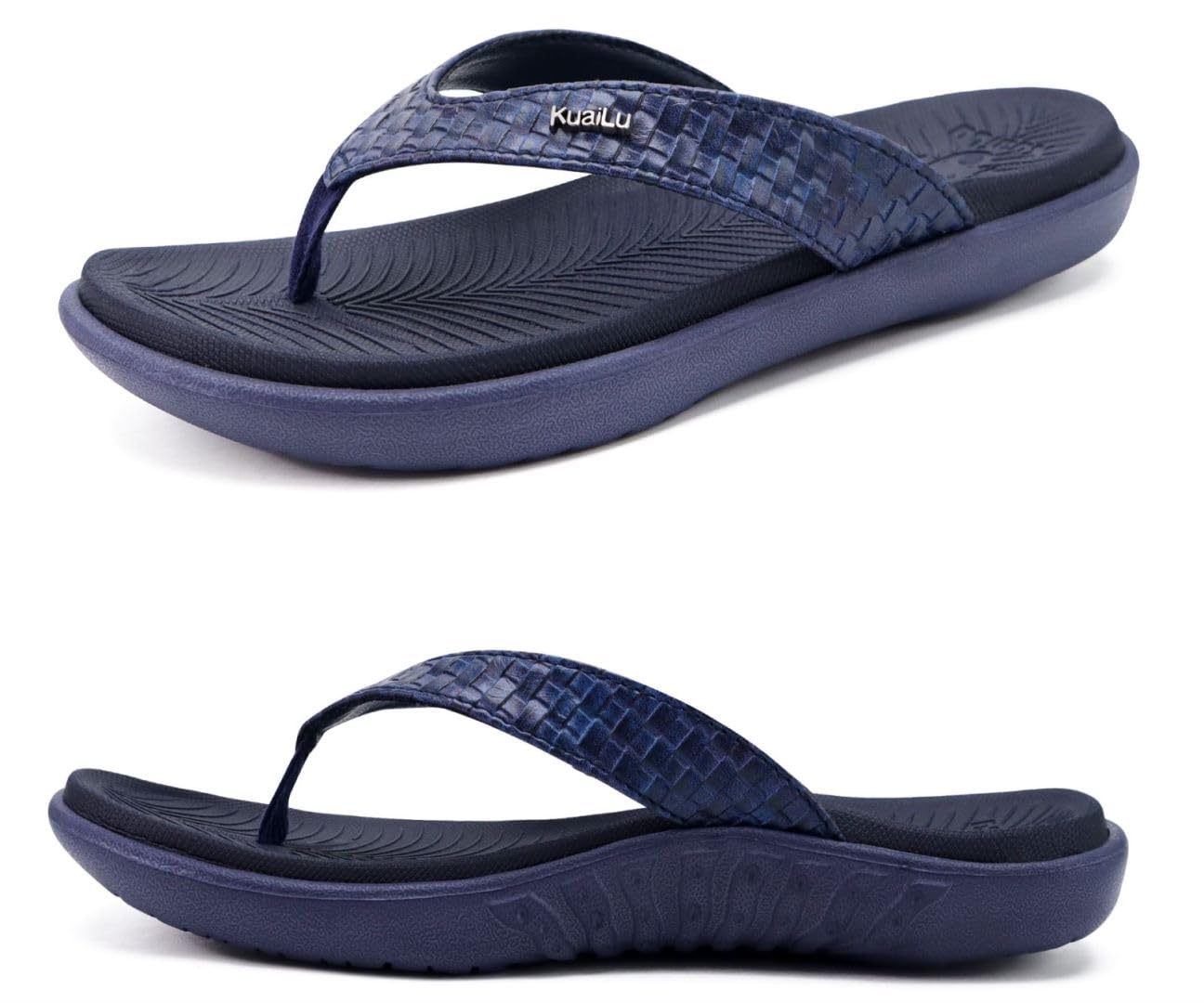
A cushioned, contoured yoga-mat footbed with a thong strap is one common take on an everyday walking sandal.
The midsole-rigidity trap
Here's a counterintuitive point worth internalizing. The instinct is to chase the softest, most pillowy sandal you can find. But for walking, a footbed that bends too easily in the middle works against you. If the sandal folds in half at the arch, it lets the foot hinge from forefoot to heel, which lengthens the plantar fascia under load — the opposite of support. A sandal that resists that bend keeps the arch propped and the fascia at a steadier length. This is why a slightly firmer footbed often feels worse for the first day and better for the next month.
A small heel lift helps too
Many supportive sandals build in a modest heel lift, often around half an inch to an inch. That isn't about height — it slightly slackens the Achilles tendon and calf chain, which in turn reduces tension transmitted to the plantar fascia at its origin. If your calves are tight (a very common contributor to heel pain), that small ramp can make a real difference on a long day. It's one more reason a purpose-built walking sandal beats a flat one for distance.
Do Arch Support Sandals Help Plantar Fasciitis?
For the specific case of plantar fasciitis, the evidence and clinical consensus are encouraging — with realistic expectations attached.
Most plantar fasciitis cases respond to a combination of stretching and arch support within roughly 6 to 12 weeks, and supportive footwear is a core part of that, according to podiatrist treatment guidance. The same sources note that time spent in flat flip-flops is consistently associated with symptoms getting worse, while supportive footwear is associated with relief. So if you have plantar fasciitis and you live in flat slides all summer, swapping to a contoured sandal is one of the higher-leverage changes you can make.
But two honest caveats matter here.
Caveat one: they're a tool, not an all-day cure
Podiatrists generally recommend treating therapeutic sandals as limited-wear, not 16-hour footwear. The common guidance is to cap supportive-sandal time around 6 to 8 hours a day and switch to a proper supportive walking or running shoe for sustained standing or any walk beyond about 30 minutes, per podiatrist guidance on plantar fasciitis sandals. In other words, an arch-support sandal is a genuine upgrade over a flat one, but it isn't a replacement for a closed, supportive shoe when your feet are working hardest.
Caveat two: the sandal must actually contact your arch
A "plantar fasciitis sandal" only works if its arch contour meets your arch. If the support is too low for a high arch, or sits in the wrong place, it does little. If it's far too aggressive for your foot, it can create new pressure points. This is the gap between a sandal that lists "arch support" as a keyword and one whose footbed is genuinely shaped to load the midfoot. The 2014 study above measured a real lift only because the footbed was properly contoured — geometry is the whole game.
If your main reason for shopping is heel or arch pain, it's worth reading a focused single-product breakdown to see how these features show up in a real sandal. Our research-based look at the KuaiLu women's arch-support flip flops walks through the footbed, heel design, and who the pair suits — a useful concrete example of what "contoured" should mean in practice.
Arch Support Sandals vs. Flat Sandals: When the Upgrade Is Worth It
Not everyone needs to retire their flat sandals. The honest framing is about matching the sandal to the job.
A flat slide or a simple thong is perfectly fine for short, low-demand stretches: a few minutes poolside, slipping out to grab the mail, a short stroll on the beach where the sand itself cushions your step. For those uses, paying extra for engineered arch support is mostly wasted money.
The upgrade earns its price when any of these is true:
- You're on your feet a lot. Travel days, theme parks, city walking, long market trips, hours of standing.
- You have a known foot condition. Plantar fasciitis, flat feet, fallen arches, or recurring heel pain.
- You feel it afterward. If flat sandals leave your arches, heels, or lower legs aching by evening, that's your foot telling you it's been doing the support work the sandal should have done.
- You wear sandals as primary footwear for months. In a hot climate, sandals aren't occasional — they're your daily shoe, and daily footwear deserves real support.
What a flat sandal silently costs
The reason flat sandals feel fine and then betray you is that the cost is cumulative, not immediate. With no arch contour, the arch drops fully each step; with no heel cup, the heel rolls freely; with a thin sole, impact travels straight up. None of that hurts on step ten. It's steps ten thousand through twenty thousand, the ones a long day actually contains, where the difference shows up as fatigue and strain, a pattern podiatrists describe when comparing flat flip-flops to supportive footwear. Worth-it, in other words, is really a question about how many steps you take.
Where Arch Support Sandals Are Oversold
A fair answer has to include the times the upgrade isn't worth it, or doesn't deliver what the marketing implies. Three honest limits stand out.
Built-in support is not a custom orthotic
A common assumption is that a $40 "orthotic" sandal does what a podiatrist's custom device does. It doesn't, and the difference is real. Custom orthotics are individually made to hold your specific foot in a neutral position using gait analysis and scanning, while over-the-counter arch supports are generic and "are not" designed to hold the foot in neutral the same way, as one orthotics clinic explains the distinction. For most healthy feet, the generic support in a good sandal is plenty. For a complex biomechanical problem, a sandal's molded footbed is a helper, not a substitute for a professional device — and custom orthotics, which can run several hundred dollars, exist precisely because some feet need more.
Soft footbeds compress and lose their support
The footbed that wows you in week one may not be the footbed you have in month six. Foam and gel materials compress with use and can lose meaningful support within a few months, as orthotics-focused buying guidance notes. That's not a reason to avoid arch-support sandals — it's a reason to weigh footbed durability, prefer firmer EVA or cork over plush gel for heavy use, and accept that a daily-driver sandal is a consumable, not a forever purchase. Independent product testing from Consumer Reports on over-the-counter orthotics reinforces that not all support inserts perform equally, which applies just as much to the support molded into a sandal.
There's usually a break-in period
A properly contoured footbed can feel odd at first because it's repositioning a foot that's used to collapsing. Cork-and-latex footbeds in particular mold to your feet over time rather than feeling perfect on day one, as podiatrist walking-sandal guidance describes for molded footbeds. The mistake is judging an arch-support sandal by its first hour. Give a genuinely supportive footbed a week of gradual wear before deciding it's wrong for you — and conversely, if a sandal feels instantly, effortlessly cushy with no adjustment at all, ask whether it's really supporting anything.
How to Tell If a Sandal's "Arch Support" Is Real
Since the whole question hinges on build quality, here's a practical checklist you can apply to any product page or in-store pair. These are the features podiatrists consistently point to, per their plantar fasciitis sandal criteria:
- A visibly contoured footbed. Look for a sculpted shape with a raised arch area, not a flat plank with a logo. The contour is the part the research measured.
- A deep heel cup. A recessed pocket that cradles the heel — this is what limits calcaneal eversion. A flat heel area is a tell that the "support" is shallow.
- Midsole firmness. Press the middle of the sole. It should resist folding in half. If it bends easily at the arch, it won't hold the arch under load.
- Secure straps. Straps that hold the foot in place so you're not gripping with your toes. Adjustable straps help dial in fit, which matters because support only works when your foot sits where the contour expects it.
- A modest heel lift. A slight ramp from heel to toe to ease Achilles and calf tension.
- Honest sizing and fit. Support that's misaligned with your arch is support you can't use. Read sizing notes and, for a high or low arch, favor pairs known to suit your arch height.
Cross-check the claims against the maker's specs
One more research habit that protects you: read the manufacturer's own description, not just the retailer blurb. Brands describe the footbed material, the support claim, and the construction in their own words, and that's the closest thing to a primary source you'll get short of holding the sandal. KuaiLu, for instance, describes its sandals as offering "fantastic arch support to help relieve foot pain" with a "contoured arch support" and a cushioned yoga-mat footbed made from TPE foam, on the brand's own site. Whether a specific claim holds up for your foot is individual — but checking that the spec actually names a contoured footbed and a real footbed material, rather than vague "comfort," is a quick filter against sandals that only support the keyword.
Matching Support to Your Arch Type (Where Most People Go Wrong)
"Arch support" implies one thing, but feet come in three rough categories, and the right amount of support differs for each. Getting this match wrong is the single most common reason someone buys a "supportive" sandal and decides arch support "doesn't work for me."
High arches
A high, rigid arch doesn't flatten much, so it's a poor natural shock absorber and tends to concentrate pressure on the heel and ball of the foot. High-arched feet usually want generous cushioning plus a contour that fills the gap under a tall arch — without that fill, the arch is floating and the support contributes nothing. If your inserts always seem to "press the wrong spot," a too-low contour for a high arch is a frequent culprit, which is one of the failure modes over-the-counter supports run into when they "support what is already too high," as orthotics guidance notes about supination and high arches.
Low arches and flat feet
A low or collapsing arch over-pronates: it rolls inward and asks the plantar fascia to do extra work. This is the foot type that benefits most from a firm, structured footbed and a deep heel cup, because the support is actively resisting a collapse that's already happening. Flat-footed shoppers who've only ever worn flat sandals often feel the biggest improvement from switching — and the biggest initial strangeness, since their foot is being held somewhere it isn't used to being.
Neutral arches
A neutral arch has the most leeway. Almost any well-built contoured sandal will feel fine, so the deciding factors become cushioning preference, strap comfort, and durability rather than corrective support. If you're neutral and pain-free, "worth it" is mostly about long-day comfort, not therapy.
The takeaway: don't ask "is arch support good?" in the abstract. Ask "is this arch support shaped for my arch?" A pair that's transformative for a flat-footed friend can feel like a lump of plastic under a high arch, and vice versa. When in doubt, favor sandals with adjustable straps and, for closed shoes, the option of a removable footbed so you can swap in an insert sized to your arch — sandals with a deeper footbed leave room for that, as insole guidance for sandals points out.
So, Are They Worth It? A Straight Verdict
Pulling the threads together:
Yes, if you walk a lot, stand a lot, have foot pain, or wear sandals as daily footwear. The biomechanics are sound and measured — a contoured footbed genuinely lifts and supports the arch, a deep heel cup steadies the heel, and a firm midsole keeps the plantar fascia from over-stretching. For plantar fasciitis specifically, supportive sandals are part of a treatment approach that resolves most cases in a couple of months, provided you also stretch and don't treat them as 16-hour shoes.
No, or not necessarily, if your sandal use is brief and casual, if the "support" sandal you're eyeing has a flat footbed and a shallow heel area (it's marketing, not mechanics), or if you're expecting a $40 sandal to replace a prescribed orthotic for a serious condition.
The honest bottom line is that "arch support sandals" isn't one product — it's a spec sheet. A well-built one is one of the better small upgrades you can make for foot comfort over a busy summer. A poorly built one is a flat sandal wearing the right words. Now that you know which features separate the two, you can shop the spec, not the slogan.
For the next step, our ranked picks in the best women's warm-weather sandals guide sort real options by use case, and the focused KuaiLu arch-support sandal breakdown shows what a contoured everyday pair looks like up close.
Related Posts