

Two hard coolers can sit side by side at the same price and perform nothing alike. One holds ice through a long weekend in the sun. The other is lukewarm by Sunday morning, your sandwiches floating in melt. The boxes look similar, the marketing copy reads the same, and the quart number printed on the lid tells you almost nothing about how cold it will actually keep your food. That gap, between what a cooler claims and what it does, is the whole reason this guide exists.
Learning how to choose a hard cooler is less about chasing a brand name and more about reading a short list of technical signals correctly, then matching them to how you actually use the thing. A cooler that is perfect for a tailgate is the wrong tool for a five-day backcountry float, and the most expensive box on the shelf is often overkill for a Saturday at the beach. Below is the checklist that separates a genuinely capable cooler from one that simply looks the part.
A quick word on method, because it matters for trust. We do not buy every cooler and run our own melt tests. This guide synthesizes manufacturer specifications, the construction and insulation principles documented by cooler makers, and independent lab and editorial testing from outlets like Consumer Reports and America's Test Kitchen. Where a number appears, it is anchored to a source you can check yourself. The goal is to translate that body of evidence into plain-language buying criteria you can apply in a store aisle or a product listing in about five minutes.
Start with how you actually use it
Before any spec matters, answer one question honestly: what is this cooler for? The answer narrows the field faster than any feature comparison, because the trade-offs that make a cooler great for one job make it mediocre for another.
A cooler built for maximum ice life is heavy, bulky, and expensive. A cooler built to disappear into a closet between trips sacrifices some of that ice life for portability. A cooler you wheel across a parking lot to a tailgate prioritizes size and rolling hardware over backcountry durability. None of these is "better" in the abstract. They are answers to different questions.
So sketch your real use case in three parts: how many people, how many days, and how you will move it. A solo angler doing day trips has almost nothing in common with a family packing for a week of car camping, and a cooler that delights one will frustrate the other. Once you have that picture, the rest of this checklist becomes a process of elimination rather than an open-ended hunt.
Match the cooler to the trip, not the trip to the cooler
A common and expensive mistake is buying the biggest, most rugged cooler you can afford and assuming it will cover every scenario. It will not. A 100-quart box is miserable to load into a sedan for a picnic, and a slim collapsible model is the wrong call for a hunting camp where you need a week of ice retention. Buy for your most frequent trip, then rent, borrow, or own a second smaller cooler for the outliers. One right-sized cooler beats one oversized cooler nearly every time.
What size hard cooler do I need?
Capacity is the first number most people look at and the one most often misread. The quart figure on the lid is total interior volume, not usable food space. You lose a large share of that volume to ice.
The widely cited planning rule is roughly one quart of capacity per person per day as a bare minimum, but that baseline assumes you are not also storing much ice, which you always are. A more realistic approach, drawn from cooler makers' own sizing guidance, is to estimate your food and drink volume, then add 25 to 50 percent on top for ice. As Mammoth Coolers notes in its sizing guide, a meaningful chunk of any cooler's interior is consumed by ice, so a 60-quart box does not hold 60 quarts of food.
In practice that shakes out to a few rough brackets. A solo traveler or a pair on a one or two-day outing is well served by something in the 16 to 35-quart range. A small group over a weekend usually lands in the 35 to 50-quart zone. A family of four on a multi-day camping trip typically needs 50 to 70 quarts, and group or week-long trips push you toward 100 quarts and beyond.
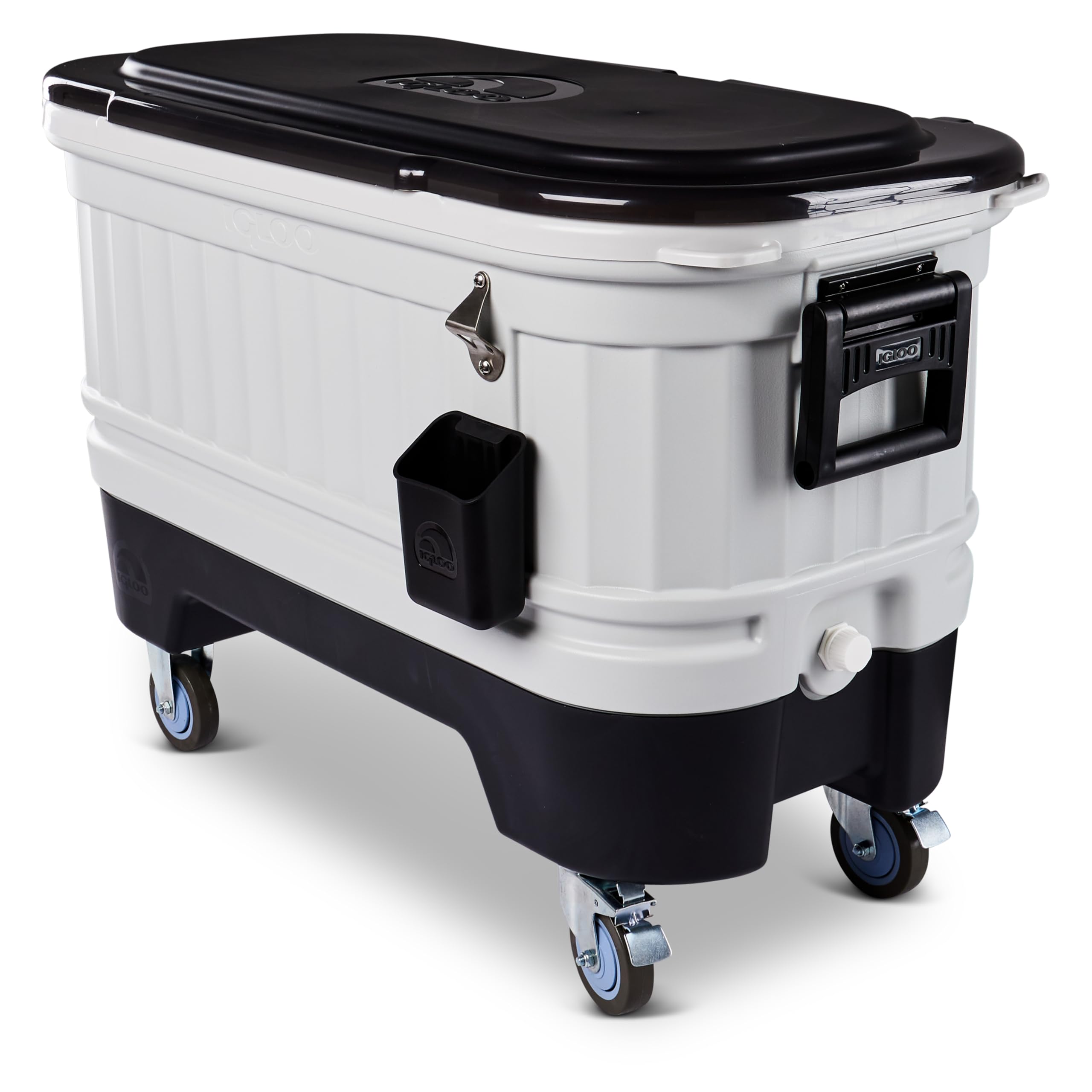
Large chest coolers in the 100-plus-quart class are sized for group trips, where capacity matters more than portability.
Best large coolers for camping run big on purpose
For car camping and group trips, big is the point. A 120-quart class chest like the Igloo Polar series holds enough food, drinks, and ice to feed a group for days, and its size is a feature rather than a flaw because you are not carrying it far. Igloo lists the 120-quart Polar at 188 twelve-ounce cans of capacity with up to five days of ice retention in temperatures up to 90 degrees, which is the territory you want for a multi-day basecamp. The trade-off is obvious: a fully loaded large cooler can weigh well over 100 pounds, so plan to position it once and leave it.
If you want a deeper look at how a value-oriented large chest like this holds up against pricier rivals, our Igloo hard cooler review breaks down where this style of cooler earns its keep and where it gives ground to premium boxes.
Best small cooler for ice retention is about ratio, not size
Counterintuitively, smaller coolers can be harder on ice, not easier. A small cooler has less thermal mass and a higher ratio of surface area to interior volume, so warm air has more relative wall to work through. The fix is the same one that helps large coolers: pack it full. Air is a far worse insulator than a dense block of food and ice, so a tightly packed small cooler holds cold dramatically better than a half-empty one. If you frequently run small loads, buy a smaller cooler and keep it full rather than buying a large one and letting it run mostly empty.
Cooler ice retention: the number that actually matters
Ice retention is the headline spec, and also the most abused one. Manufacturer "days of ice" claims are measured under ideal, controlled conditions that rarely match a real campsite in July. Treat them as a relative ranking between models from the same maker, not a promise about your trip.
What actually drives ice retention is less glamorous than a marketing number: insulation thickness, insulation type, and seal quality. Independent testing bears this out. In controlled lab testing, Consumer Reports found large performance gaps between coolers, with the best models keeping contents cold for days longer than weaker ones under identical conditions. Editorial test programs like America's Test Kitchen's hard cooler testing reach the same conclusion: construction quality, not the brand on the lid, predicts performance.
Wall thickness and insulation type
The single biggest lever on ice life is how much insulation sits between your ice and the outside air, and what that insulation is made of. Buying guidance from cooler makers consistently points to two to three inches of wall and lid insulation as the threshold for serious ice retention, with the lid being especially important because cold sinks and warm air infiltrates from the top.
Just as important is the material. Quality coolers use dense closed-cell polyurethane foam, which resists heat transfer far better than the air pockets or thin foam found in budget models. As the Field & Stream rotomolded cooler guide explains, the combination of thick walls and dense foam is what lets premium coolers stretch ice retention into the seven to ten-day range under good conditions. If a cooler's marketing emphasizes a clever color or a cup holder but says nothing about insulation thickness or foam type, that silence is itself a signal.
Seal quality: the gasket and the lid
A cooler is only as good as its weakest leak, and the lid seal is where most cold escapes. Premium coolers use a continuous rubber gasket around the lid, much like the seal on a home freezer, to choke off the warm-air exchange that melts ice. Budget coolers often skip the gasket entirely and rely on the lid simply resting in place, which lets a slow current of warm air cycle through the box all day.
When you evaluate a cooler, open and close the lid and look for a gasket. Check that latches pull the lid down snugly rather than just holding it shut. A tight, gasketed seal does more for real-world ice life than an extra half-day of advertised performance, because it protects the cold you already have.
Insulation and construction: rotomolded vs injection molded
The construction method behind a cooler tells you a lot about both its ice retention ceiling and its price. There are two broad families, and the right one depends entirely on your use case.
Rotomolded coolers are made by slowly rotating powdered plastic inside a heated mold, which produces a single seamless shell with very thick, uniform walls. The seamlessness eliminates weak points, and the thick walls leave room for deep insulation. This is why rotomolded coolers dominate the long-retention category and why, as the Field & Stream guide notes, they routinely reach seven to ten days of ice under favorable conditions. The cost is real, though: rotomolded coolers are heavy and typically run from the high one hundreds to several hundred dollars.
Injection-molded and traditional coolers are built from molded plastic panels and foam, often with thinner walls and a lighter overall build. They cost a fraction of a rotomolded box and weigh much less, which makes them the sensible choice for casual use, day trips, and anyone who values portability over squeezing out an extra two days of ice. A classic Coleman-style chest is the archetype here: not the longest ice life on the market, but a fraction of the price and weight.
The honest takeaway is that most people do not need a rotomolded cooler. If your typical outing is a day or a weekend, a well-sealed traditional cooler keeps ice perfectly well and saves you a few hundred dollars. Rotomolded construction earns its premium specifically for multi-day, off-grid trips where every extra hour of ice matters.
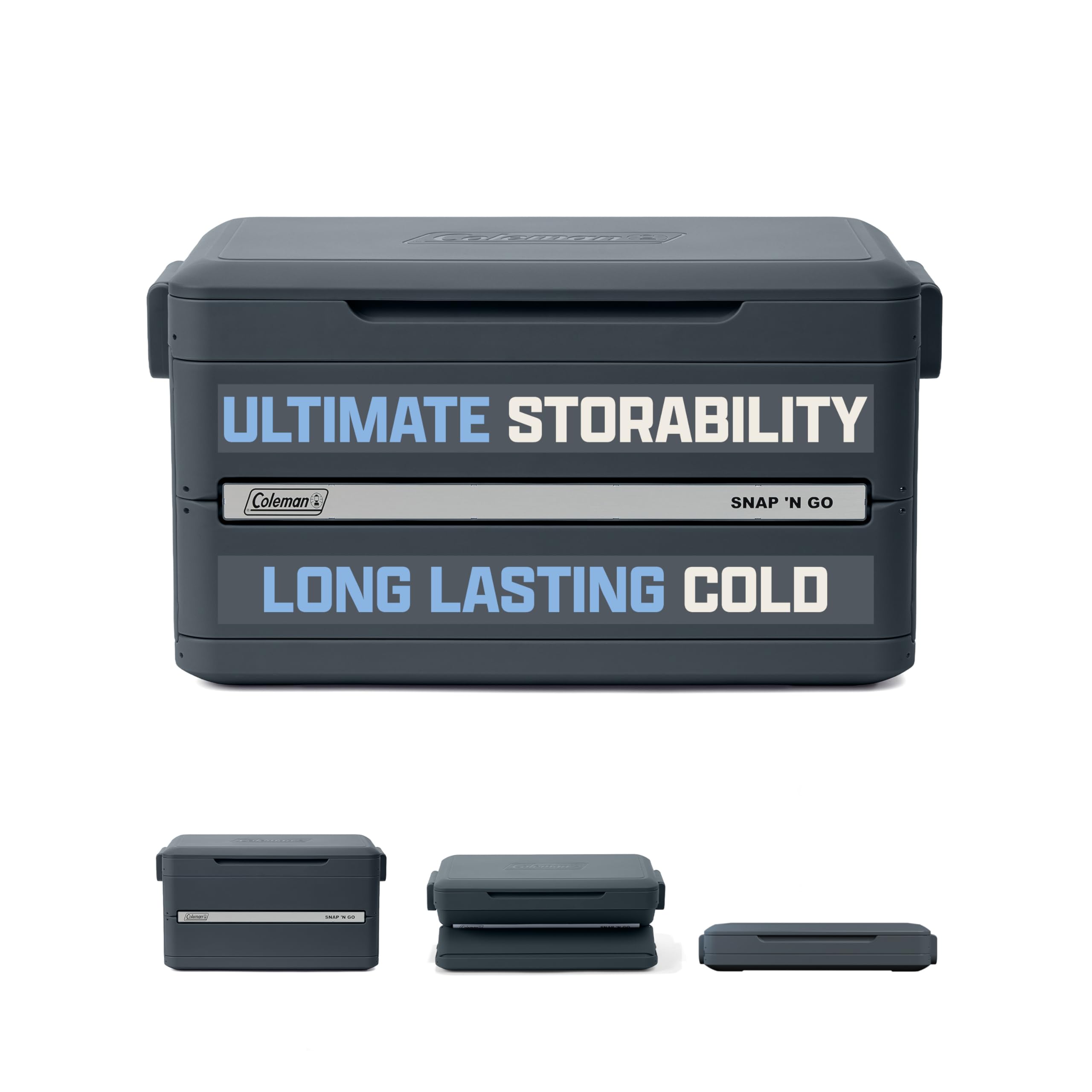
Collapsible hard coolers trade a little ice retention for the ability to fold down to a third of their size between trips.
The collapsible middle ground
A newer category splits the difference between hard and soft coolers. Collapsible hard coolers like the Coleman Snap 'N Go give you rigid, insulated walls when set up and then fold down to roughly a third of their size for storage. Coleman rates the 55-quart Snap 'N Go at 64 hours of cold, which is solidly over two days, with a fully insulated lid and body plus a waterproof removable liner for cleaning. You give up some of the absolute ice retention of a thick rotomolded box, but you gain the ability to stash the cooler under a bed or in a closet, which is a genuine win for apartment dwellers and anyone short on garage space.
Hard coolers with wheels: when rolling hardware earns its keep
Once a loaded cooler crosses roughly 60 quarts, weight stops being a footnote and becomes the dominant factor in whether you actually use it. A full 100-quart cooler can hold dozens of cans plus 50 pounds of ice, which is more than most people can comfortably carry any distance. That is where wheels stop being a gimmick and start being the feature that makes the cooler usable.
Not all wheels are equal. Look for larger wheels, in the range of six inches, that can handle grass, gravel, and parking-lot transitions rather than tiny casters that bog down the moment you leave smooth pavement. The Coleman Classic wheeled cooler, for example, pairs a 100-quart capacity with heavy-duty six-inch wheels and a tow handle, and Coleman rates it to keep ice up to five days in temperatures as high as 90 degrees. For tailgates, campgrounds with a long walk from the lot, and beach days, a wheeled cooler is the difference between bringing enough and bringing what you can lug.
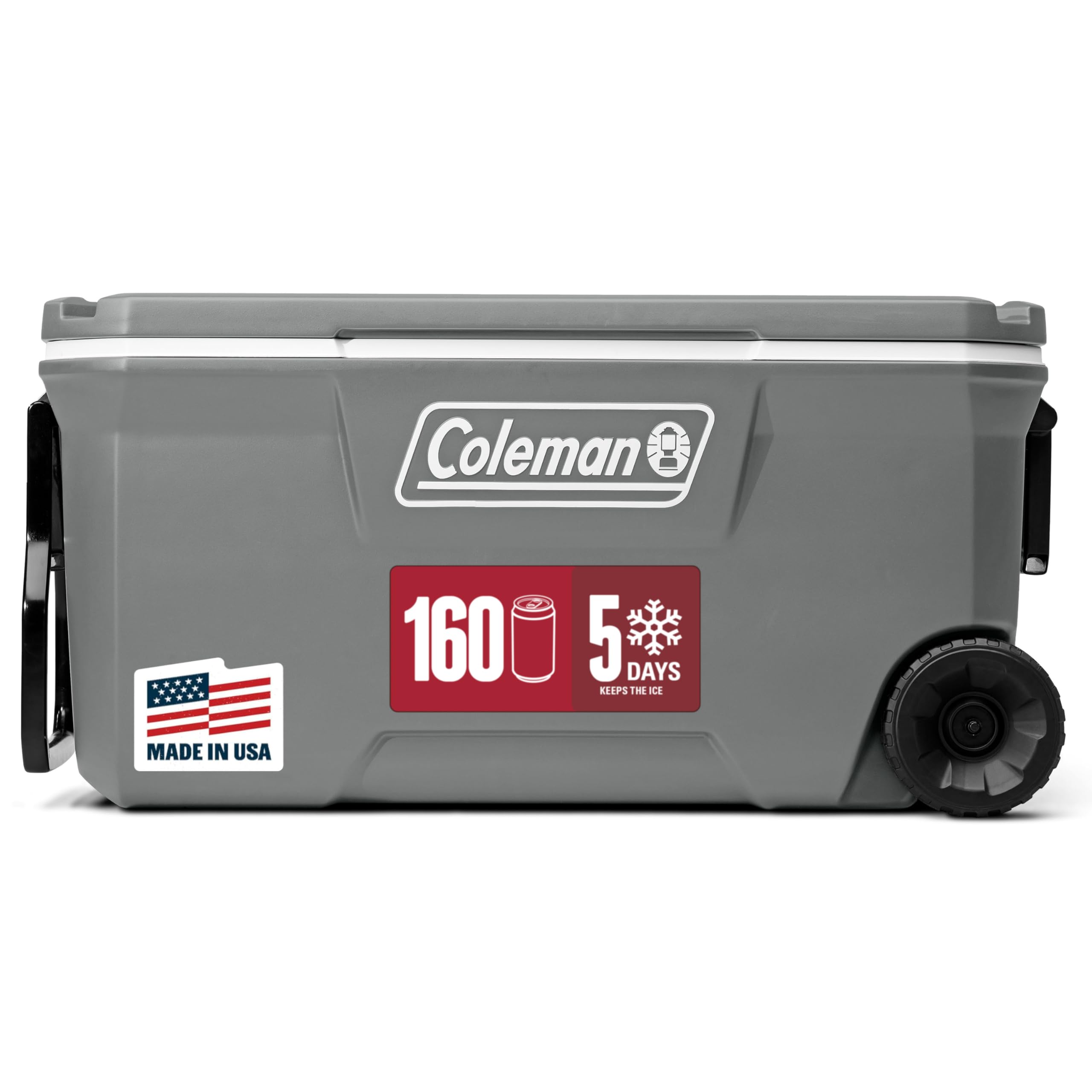
Large six-inch wheels and a tow handle make a 100-quart load manageable across grass and gravel.
Handles, drains, and the small hardware that matters
Beyond wheels, a few pieces of hardware separate a cooler you tolerate from one you enjoy. Swing-up or fold-down side handles are easier and more balanced for two-person carries than rope handles. A threaded drain plug, ideally one you can attach a garden hose to, makes emptying a heavy cooler far less of a wrestling match than tipping it out. Igloo, for instance, lists a threaded drain plug with hose hookup on its Polar chests, which is a small detail that pays off every single trip.
Latches matter too. Look for latches that actively pull the lid down against the gasket rather than ones that merely keep it from flopping open. On large coolers, a reinforced lid that can double as a seat is a nice bonus, but check the rated weight before anyone sits on it.
Durability, warranty, and the features worth paying for
A cooler lives a hard life: dropped tailgates, sun exposure, salt water, and the occasional curious animal. A few construction details predict how well it will age.
UV-resistant materials keep the shell from getting brittle and chalky after seasons in the sun, and a stain- and odor-resistant liner keeps the interior from turning into a science experiment after one forgotten fish. For anyone heading into bear country, the relevant standard is certification from the Interagency Grizzly Bear Committee. A cooler is only considered genuinely bear-resistant if it carries that IGBC certification, and even then the rating typically assumes you secure the lid with the appropriate locks, which are usually sold separately. Do not assume a thick rotomolded cooler is bear-proof just because it looks tough; look for the actual certification if that is a requirement where you camp.
Warranty length is a useful proxy for a manufacturer's confidence. Reputable cooler brands back their products with multi-year to lifetime warranties against material and workmanship defects. A short or vague warranty on an expensive cooler is worth a second look.
What to skip
Plenty of cooler features are more marketing than function. A built-in bottle opener or cup holder is convenient but should never drive your decision. "Military grade" and similar unregulated phrases promise nothing measurable. And a fashionable color costs you nothing in performance but should not cost you extra dollars either. Spend your budget on insulation, seal, and the right size; treat everything else as a tiebreaker.
Getting the most ice life out of whatever you buy
The right cooler is only half the equation. How you pack and use it routinely changes ice life by a day or more, which means smart technique can let a mid-priced cooler outperform a pricey one used carelessly.
Pre-chill the cooler before you load it. A cooler that has been sitting in a hot garage starts the trip by stealing cold from your ice to bring its own walls down to temperature. Loading it with a sacrificial bag of ice the night before, or even running it cold indoors, means your trip ice goes toward keeping food cold rather than cooling the box itself. Pre-chilling your drinks and food in a refrigerator first has the same effect: warm cans entering a cold cooler accelerate melt sharply.
Use block ice for the long haul and cubed ice for quick cooling. Block ice has less surface area relative to its mass, so it melts far more slowly and forms the cold reservoir that carries you through a multi-day trip. Cubed ice chills faster and fills gaps but disappears quickly. Many experienced packers use both: a base layer of block ice for endurance and cubes to fill the air around items. Keeping the cooler full, with cold food and ice packed tightly so there is little air to circulate, is one of the most effective and free ways to stretch retention.
Finally, manage the lid and the sun. Every time the lid opens, the cold air pours out and warm air rushes in, so a cooler opened constantly through the day will never match its rated retention. Keep the cooler in shade, off hot pavement, and out of direct sun whenever possible. A cooler in the shade can hold ice meaningfully longer than the identical cooler baking in the sun, which is why a five-day rating measured in a lab so often becomes three days on an exposed beach.
A note on the Coleman Xtreme and "days of ice" naming
Some traditional coolers, like the long-running Coleman Xtreme line, build a retention claim right into the name, with marketing pointing to as many as five days of ice. Those figures come from the manufacturer's controlled testing and, like all such claims, assume favorable conditions: a pre-chilled cooler, a full load, block ice, and limited lid openings. They are useful for ranking models within a brand's own lineup, but they are not a guarantee for your July weekend. Read every "X-day" claim, whether it is on an inexpensive injection-molded chest or a premium rotomolded box, as a best-case ceiling rather than a floor, and apply the packing technique above to get close to it.
Hard cooler or soft cooler, and what about a shoulder strap?
If you find yourself wanting a shoulder strap for grab-and-go portability, that is usually a sign you are shopping the wrong category. Shoulder straps belong to soft-sided coolers and tote-style coolers, which prioritize carry comfort and packability over the deep insulation and rigid structure that define a hard cooler. A hard cooler's advantages are exactly the things a strap cannot help with: thick walls, a sealed lid, and ice retention measured in days rather than hours. For short outings where you carry the cooler on your shoulder and need cold for only a few hours, a soft cooler is the better tool. For anything where ice life is the priority and you set the cooler down at a destination, a hard cooler with proper handles, and wheels if it is large, is the right call.
Putting the checklist together
If you strip this guide down to a buying sequence, it looks like this. First, define your trip honestly: people, days, and how you will move the cooler. Second, size for that trip and add room for ice, remembering the quart number is not usable food space. Third, prioritize ice retention through insulation thickness, dense foam, and a real gasketed seal rather than chasing an advertised "days of ice" headline. Fourth, choose your construction tier: a traditional or collapsible cooler for casual day-and-weekend use, rotomolded only if you genuinely need multi-day off-grid retention. Fifth, add the hardware your use case demands, wheels for big loads, a hose-friendly drain for easy cleanup, and check for UV resistance and a solid warranty.
Do that, and you will skip the two most common cooler-buying mistakes: overpaying for rotomolded retention you will never use, and underbuying a flimsy box that fails on the one weekend you needed it most.
When you are ready to compare specific models against these criteria, our roundup of the best hard coolers for 2026 does the head-to-head shopping for you, with picks matched to different budgets, trip lengths, and use cases. Pair it with the criteria above and you will know not just which cooler is recommended, but why it fits the way you actually shop, pack, and travel.
Related Posts