
The Short Answer: Yes, If You Match the Machine to the Building
Compact cardio machines are a good fit for most small apartments, but the honest answer has a condition attached: the machine has to suit the space and the building, not just your square footage. A folding rower or an under-desk walking pad can slide under a bed and disappear between sessions. A full-size treadmill with a hard deck can rattle a downstairs neighbor's ceiling even if it technically fits in the corner. Footprint is only half the question. Noise transfer through the floor is the other half, and it is the one most people underestimate.
The good news is that the category has matured. You no longer have to choose between a real workout and a machine you can store. Today's compact rowers, steppers, walking pads, and folding treadmills are designed around exactly this problem, and several of them hit the U.S. physical activity recommendation of 150 minutes of moderate aerobic activity per week without you ever leaving a 6-by-3-foot patch of floor.
A note on how we got here: we did not run these machines in a lab or a rental unit ourselves. This article synthesizes manufacturer specifications, published noise measurements from equipment-testing publications, and independent editorial reviews to answer the apartment question honestly. Where a number matters, we link to the primary source so you can check it yourself.
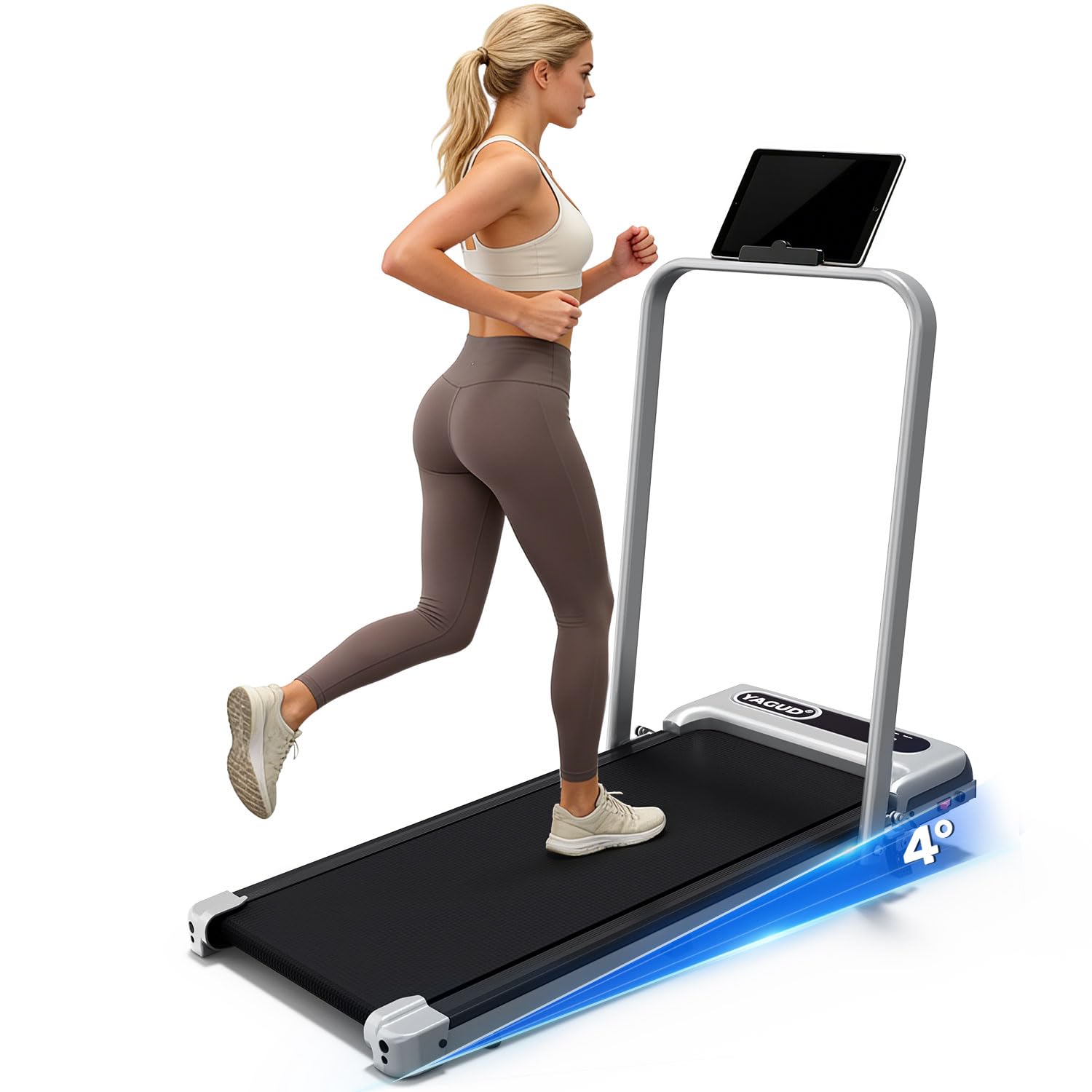
Under-desk walking pads fold flat and store under furniture, which is why they top most apartment cardio lists.
Why Small Apartments Need a Different Kind of Cardio Machine
The phrase "compact cardio machine" gets thrown around loosely, so it helps to be precise about what an apartment actually demands. Three constraints matter more than anything else.
Footprint and Storage Are Not the Same Thing
A machine can have a small in-use footprint and still be a storage nightmare, or vice versa. When you shop for compact workout equipment for an apartment, look at two numbers: the space needed to use it, and the space needed to store it.
A magnetic rower is a good illustration. MERACH lists its dual-rail home rower at 65 by 19.3 inches in use, but the recommended storage footprint shrinks to roughly 1.6 by 2.1 feet once it is folded and stood upright, per the manufacturer's product specifications. That gap, in-use versus stored, is the whole game in a studio or one-bedroom. You want the machine to be present only during your workout and invisible the rest of the day.
Walking pads take this even further. Folding under-desk models routinely collapse to around five inches thick. The WalkingPad C2, for example, folds to a 5.4-inch thickness so it can slide under a bed or sofa. For an apartment, "stores flat under the bed" is often the single most valuable spec on the sheet.
Floor Noise Travels Further Than Motor Noise
This is the constraint apartment dwellers learn the hard way. The whir of a motor is airborne noise, and it is usually modest. Under-desk treadmills like the Yagud walking pad are rated to run below 45 dB, roughly the level of a quiet library. Treadmill testers measuring motor output more broadly put most home units in the 40 to 60 dB range, comparable to light conversation.
The problem is structural noise, not airborne noise. As one equipment guide puts it, the energy from a footstrike travels through the machine into the floor joists and effectively turns your neighbor's ceiling into a speaker. That is why the quietest number on a spec sheet can still produce complaints: the spec measures the sound near the machine, not the thump transmitted into the unit below. Machines where your feet leave a surface and land again (running, high steps) are the worst offenders. Machines where your feet stay in contact with a pedal or seat, or where you stay seated entirely, are the safest bets for an upstairs apartment.
You Are Buying for a Lease, Not a Basement
A homeowner can bolt a machine to a concrete slab and forget about it. A renter has thin floor assemblies, shared walls, and a security deposit on the line. That changes the calculus toward lighter, quieter, foldable equipment and away from heavy, high-impact, permanently-installed gear. It also makes a good floor mat non-negotiable, which we will cover below.
There is a related point about ceiling height that rarely makes it onto a spec sheet. Tall steppers, ellipticals with a high stride, and any machine you stand on raise your head several inches above the floor. In a basement-conversion apartment or a unit with low ceilings, that can put a running stride uncomfortably close to a ceiling fan or light fixture. Seated machines like rowers and bikes sidestep the problem entirely, which is one more quiet reason they suit awkward small spaces so well.
Measure the Real Space Before You Buy
Before you commit to any machine, measure the actual patch of floor you will use, then add clearance. A rower needs runway behind the seat for the slide. A treadmill needs room to step on and off safely and a buffer behind it in case you drift back. A walking pad needs almost nothing beyond its own deck. The classic apartment mistake is buying to the machine's folded dimensions and then discovering there is nowhere to unfold it. Tape out the in-use footprint on your floor first, stand in it, and make sure you can move freely before anything ships.
Best Home Cardio Equipment for Small Spaces, Ranked by Apartment-Friendliness
If you sort cardio machines by how well they behave in a small upstairs apartment, a clear order emerges. The ranking below is about apartment fit specifically, not overall fitness value, and it leans on the noise and footprint principles above. For a full side-by-side of specific models, our guide to the best compact home cardio machines breaks down each category with specs.
Walking Pads: The Most Apartment-Friendly Footprint
Under-desk walking pads win the apartment test more often than any other category, and it is not close. They fold flat, store under furniture, run quietly, and keep your feet in steady contact with the belt at walking speeds, which limits the impact that travels downstairs.
The trade-off is intensity. A typical walking pad tops out around 3.8 mph, enough for brisk walking but not running, and supports a 265-pound user on a 2.5 HP motor. For someone whose goal is to hit a daily step count, undo the damage of a desk job, or accumulate the recommended 150 weekly aerobic minutes, that ceiling is rarely a real limit. If a walking pad sounds like your match, we go deeper on belt cushioning, deck size, and quiet operation in our Yagud walking pad review.
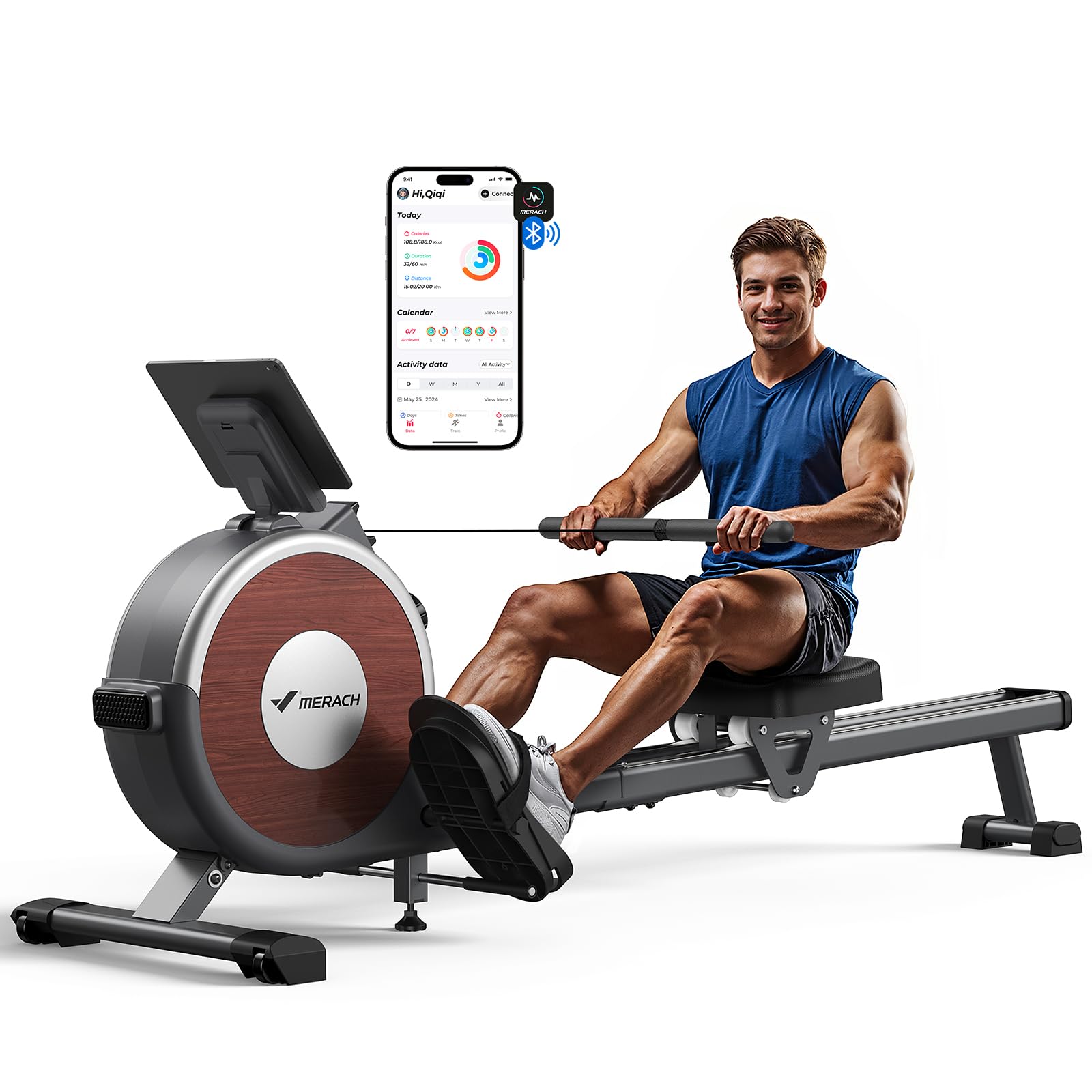
Magnetic rowers deliver full-body cardio with near-silent resistance and fold upright for storage.
Magnetic Rowers: Quiet, Full-Body, and Foldable
Rowing is the dark horse of apartment cardio. You stay seated, so there is no footstrike to transmit through the floor, and magnetic resistance is effectively silent. Resistance is the detail that matters here: magnetic mechanisms are virtually silent and low-maintenance, while air and friction rowers are loud, which is why equipment guides steer apartment buyers toward magnetic resistance.
A rower is also a better core machine than most people expect, which matters if a flatter stomach is part of your goal. Rowing is a full-body movement that recruits the midsection through every stroke, so it engages the core far more than a stationary bike or a treadmill walk. It is cardio and core work in one motion. The MERACH dual-rail rower folds to roughly a 1.6-by-2.1-foot storage footprint and carries a 350-pound capacity, per the manufacturer's listing, which makes it one of the more storable serious machines on the market.
Steppers: Small Footprint, Low Impact, Senior-Friendly
A compact stepper is one of the smallest serious cardio options you can buy, which makes it a strong answer for small exercise equipment for seniors and anyone prioritizing joint-friendly movement. Low-impact steppers keep one foot loaded at all times, so there is no jarring landing, and the better designs add resistance bands to turn a leg workout into a fuller-body session. Their tiny footprint means they tuck into a closet between uses.
The caveats are real: a stepper trains a narrower movement pattern than a rower or treadmill, and balance-style 3D steppers ask more of your stability than a fixed machine does. For an older adult or anyone returning to exercise, that can be a feature (gentle, controllable) or a drawback (less stable), so it is worth matching the model to the user.
Folding Treadmills: Most Versatile, But Mind the Floor
A folding treadmill is the most versatile machine on this list because it covers walking, jogging, and running on one deck. Consumer Reports notes that some top-scoring foldable treadmills rate nearly as well as full-size units and store at about half their length, so you are not sacrificing much capability for the fold.
The asterisk is impact. The moment you run rather than walk, you reintroduce the footstrike that travels through the floor. For an upstairs apartment, a folding treadmill is excellent for walking and incline work and risky for running unless you invest in serious floor isolation. A cushioned deck helps, but it does not eliminate transmitted vibration on a second floor.
Best Equipment for a Small Home Gym Beyond the Cardio Machine
A single cardio machine covers the aerobic side of fitness, but the physical activity guidelines also call for muscle-strengthening work on two or more days a week. The encouraging part for apartment dwellers is that the strength half of a small home gym needs almost no floor space at all.
Compact Home Gym Equipment That Stores in a Drawer
The most space-efficient strength tools are the ones that disappear into a closet or under the bed. Resistance bands, a suspension trainer that anchors to a door, and a single adjustable kettlebell can replace a rack of fixed weights. This is the practical answer to compact home gym equipment and compact home gym weights: you do not need a power rack to satisfy the strength recommendation, you need a handful of versatile, storable tools and a consistent routine.
Many compact cardio machines also blur the line here. A 3D motion stepper bundled with resistance bands, for instance, doubles as a lower-body and upper-body station, so a single purchase covers both cardio and light resistance. That kind of overlap is exactly what a small space rewards.
Bodyweight Work Is the Original Compact Equipment
It is worth saying plainly that the cheapest, quietest, smallest-footprint strength equipment is no equipment at all. Push-ups, squats, lunges, and planks build strength with zero gear and zero noise, and low-impact interval styles deliver real results without the bouncing that bothers neighbors. If budget or space is tight, a cardio machine plus a yoga mat and a band is a complete small-apartment gym.
How to Make Any Compact Cardio Machine Apartment-Safe
Choosing the right machine is most of the battle. A few setup decisions handle the rest, and they apply whether you bought a walking pad, a rower, or a folding treadmill.
Put a Proper Mat Underneath, Not a Yoga Mat
This is the single highest-leverage move for an upstairs unit. A thin foam or yoga mat does almost nothing for structural noise. Equipment guides are specific: a high-density rubber mat, around three-quarters of an inch thick, acts as a structural buffer that absorbs mechanical energy before it enters the building frame, where a standard mat is simply too thin to matter. Treat the mat as part of the machine's cost, not an optional accessory.
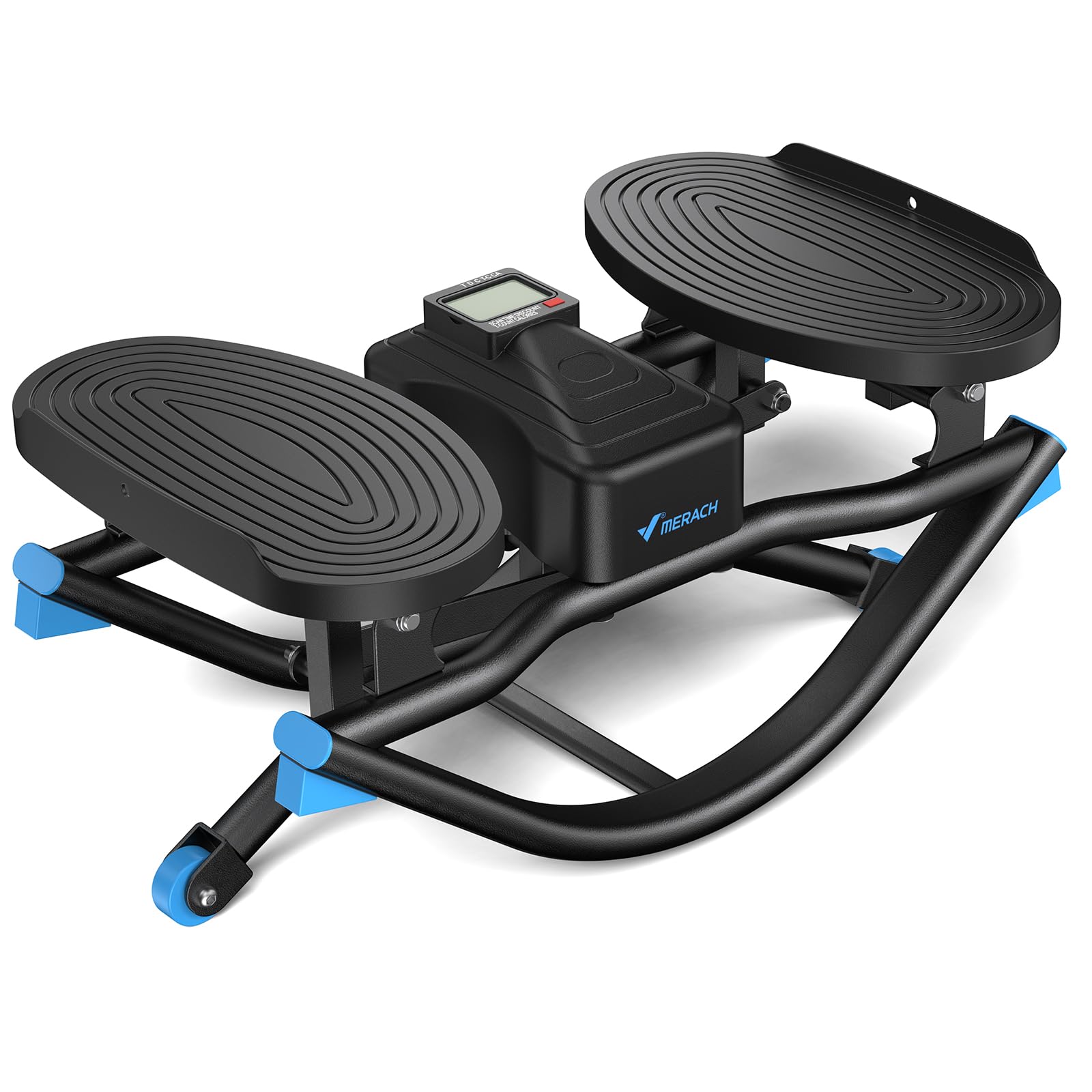
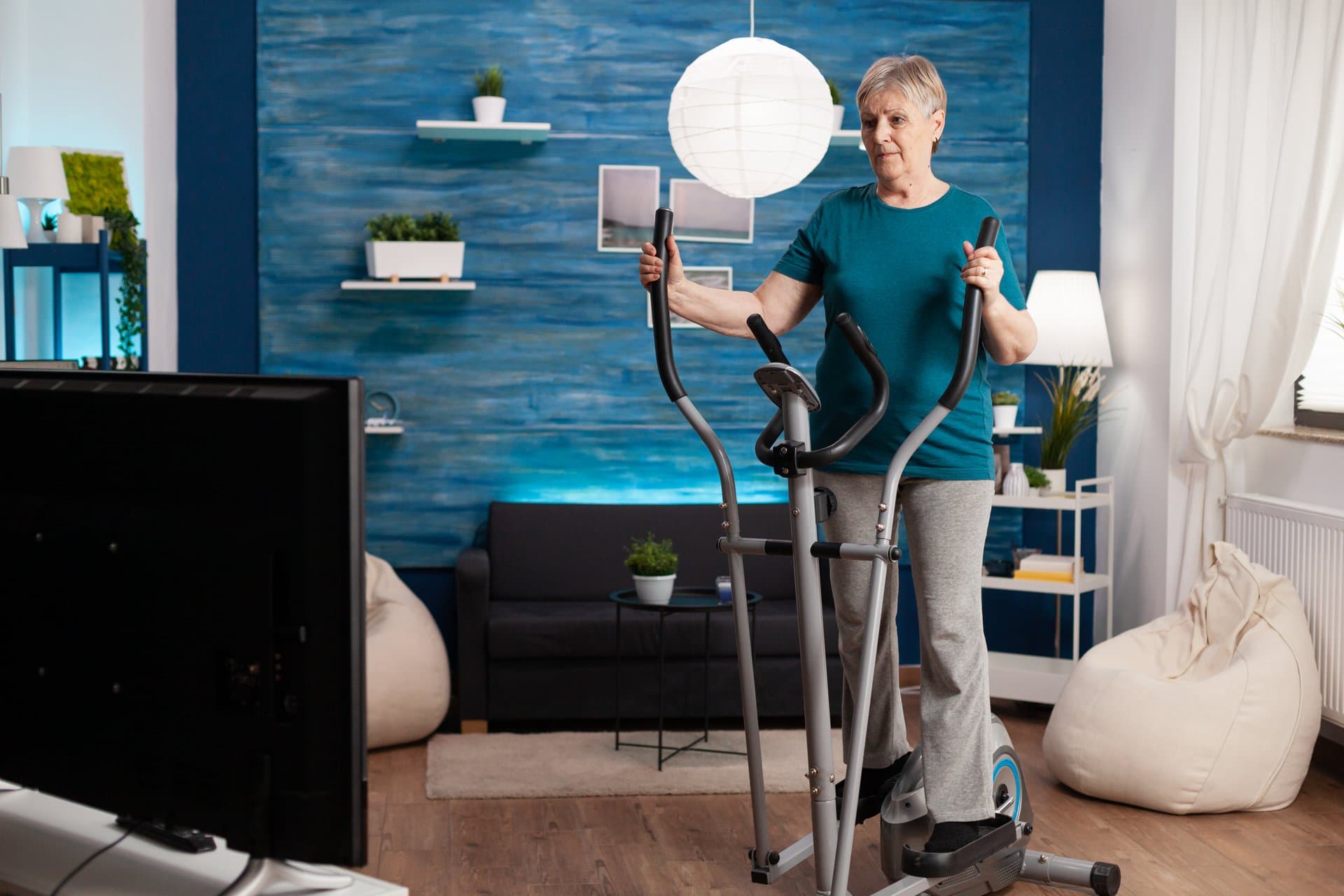
A low-impact stepper has one of the smallest footprints in cardio and suits seniors and joint-conscious users.
Favor Magnetic and Seated Movements for Quiet Operation
If noise is your top concern, the hierarchy is clear. Seated machines with magnetic resistance (rowers, magnetic bikes) are quietest because there is no footstrike at all. Walking pads come next, since your feet stay in contact with the belt. Running on a treadmill is loudest. When in doubt, pick the quiet cardio machine that keeps you seated or keeps your feet planted.
Mind Your Hours and Your Layout
A little courtesy goes a long way in a building. Schedule the higher-impact sessions for daytime hours rather than early morning or late night, and position the machine over a load-bearing wall or a corner rather than the dead center of a room, where the floor flexes most. These cost nothing and meaningfully reduce the odds of a complaint.
Budget for the Whole Setup, Not Just the Machine
The sticker price of a compact cardio machine is rarely the full cost in an apartment. A quality three-quarter-inch rubber mat, and sometimes a second layer of anti-vibration pads under the machine's feet, adds to the total but pays for itself the first time it keeps the peace with a downstairs neighbor. Factor in the accessories from the start so you are not tempted to skip the one component that actually protects your lease. The reassuring news is that the floor protection costs a small fraction of the machine, and a single mat outlasts several pieces of equipment.
What Compact Cardio Machines Cost, and What That Buys You
Price tracks roughly with category, and understanding the tiers helps you avoid overbuying for an apartment. Walking pads and basic magnetic rowers sit at the affordable end, compact steppers are often the cheapest serious cardio option, and folding treadmills with motors, cushioned decks, and incline climb into a higher bracket. Because apartment living rewards lower-impact, lower-footprint machines, the apartment-friendly choices are frequently the more affordable ones, which is a pleasant inversion of how home gym shopping usually feels.
Value, though, is not the lowest price. It is the machine you will actually use. A modestly priced walking pad that lives under your desk and accumulates daily steps delivers more real health benefit than an expensive treadmill that gets folded against the wall and forgotten because running upstairs feels antisocial. When you assemble the best equipment for a small home gym, weight convenience and quiet operation heavily, because in a small space those two traits are what drive consistency, and consistency is what produces results.
Common Concerns, Answered
Is a Walking Pad Enough of a Workout for a Small Apartment?
For most goals, yes. Walking is a legitimate form of moderate aerobic activity, and the guidelines explicitly count brisk walking toward the weekly 150-minute target. A walking pad's value is that it removes the friction of leaving the apartment, which is what actually drives consistency. If your goal is running performance, a walking pad is not your machine, but for general health, daily steps, and active recovery, it is more than enough.
Will a Compact Treadmill Disturb Neighbors Below Me?
It can, and walking versus running is the dividing line. Walking on a cushioned deck over a thick rubber mat is usually fine. Running reintroduces the footstrike that travels through the floor, and no cushioned deck fully cancels that on a second story. If you live above someone and want to run indoors, plan for serious floor isolation, or choose a rower or magnetic bike instead so the question never comes up.
What Is the Best Single Machine for the Tightest Apartments?
If you have to pick one machine for the smallest possible space with the least risk of neighbor complaints, an under-desk walking pad is the safest default. It stores under the bed, runs quietly, and keeps impact low. If you want a more complete, full-body workout and can store a slightly larger folded item, a magnetic rower is the strongest runner-up. Both let you skip the gym membership without renovating your unit.
The Bottom Line
Compact cardio machines are genuinely good for small apartments, and the category has gotten good enough that "small space" is no longer a real excuse to skip cardio. The trick is to stop thinking only about whether a machine fits and start thinking about how it behaves once it is running. Prioritize a small stored footprint, magnetic or low-impact movement, and a proper rubber mat, and a studio or one-bedroom can host a complete home gym that meets the weekly activity guidelines without ever bothering the unit below.
Match the machine to the building, not just the floor plan, and the answer to the title question is a confident yes. To compare specific models head-to-head, start with our guide to the best compact home cardio machines, and if the apartment-friendliest footprint is your priority, our Yagud walking pad review digs into the model most people in small spaces end up choosing.
Related Posts