
The Short Answer: Yes, but "Cooling" Means Two Very Different Things
If you have ever flipped your pillow to the cool side at 2 a.m., you already understand the appeal of a cooling comforter. The honest answer to whether they work is a qualified yes, with an important asterisk: a good cooling comforter changes how quickly heat leaves your body and how dry your skin stays, but almost none of them refrigerate you the way an air conditioner does. They manage heat. They do not generate cold.
That distinction is the whole ballgame, and it explains why some people swear by their cooling comforter while others feel cheated. Once you understand the physics of what these products actually do, you can predict fairly accurately whether one will help you, and which type to buy. This article walks through the sleep science, the three real mechanisms at play, who benefits most, and where the marketing outruns the evidence.
A quick note on method: we did not run a sleep lab or test these comforters on a thermal mannequin ourselves. This is a research-based explainer. The claims below are drawn from peer-reviewed sleep physiology, clinical guidance from medical institutions, and published product testing, all linked inline so you can check the primary sources. When the evidence is thin or a claim is mostly marketing, we say so.
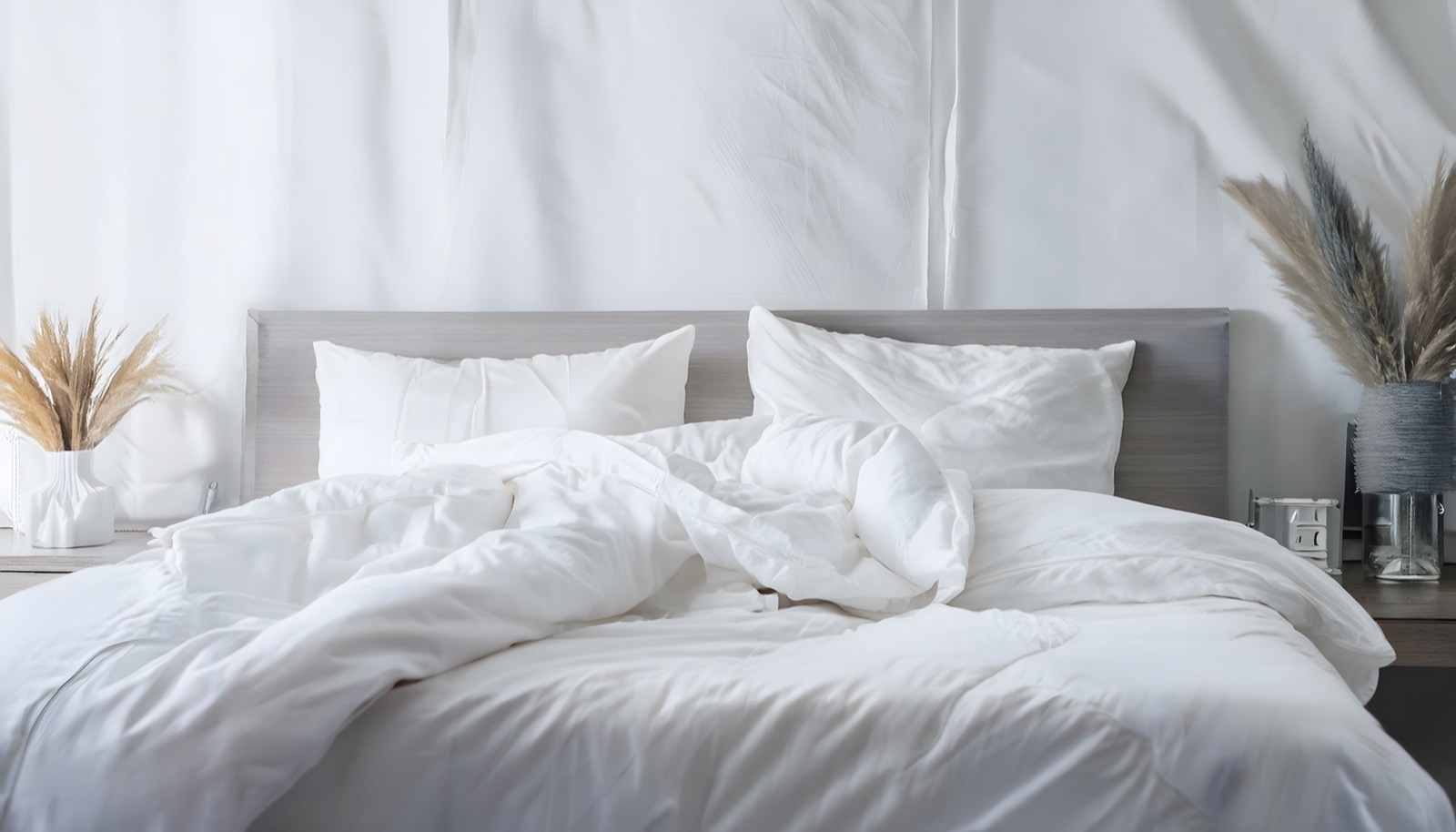
A cooling comforter manages heat flow rather than actively refrigerating the sleeper.
Why Temperature Matters So Much for Sleep
Before judging whether a comforter "works," it helps to know what it is supposed to accomplish. Sleep is unusually sensitive to temperature, more than most people realize.
Your core body temperature is not constant. It follows a daily rhythm, peaking in the early evening and then falling overnight, reaching its low point in the early morning hours. That evening decline is not a side effect of sleep. It is part of the trigger. A major review in Sleep Medicine Reviews, hosted on the National Library of Medicine, found that humans are "most likely to select a moment when the body temperature was at its maximum rate of decline" to fall asleep, and that core temperature falls roughly 2°C across the transition from wakefulness into deep sleep (NCBI / PMC review on temperature and sleep onset).
In plain terms: your body wants to shed heat in order to sleep, and anything that blocks that heat loss fights against your own biology.
This is why sleep clinicians are fairly consistent about bedroom temperature. The Sleep Foundation recommends a bedroom around 65°F (18.3°C), with most people doing well anywhere in the 60–68°F range, precisely because a cooler room makes it easier to shed core heat and stay in restorative sleep stages (Sleep Foundation: The Best Temperature for Sleep). Cleveland Clinic offers similar guidance, noting that being too warm at night is linked to lighter, more fragmented sleep (Cleveland Clinic: What's the Best Temperature for Sleep?).
Here is the catch that makes cooling comforters interesting rather than pointless: the goal is not to make your whole body cold. The same research shows it is the gradient between your warm hands and feet and your cooler core that predicts sleep. The skin gradient between your extremities and your trunk "is as much as 1.5°C" before sleep, then narrows after sleep onset, and even a tiny shift of about 0.4°C in skin temperature within the comfortable range can shorten how long it takes to fall asleep, especially in older adults with insomnia (NCBI / PMC review).
So a comforter does not need to drop your temperature by a dramatic amount. It needs to keep your skin from overheating and trapping a sweaty, humid micro-climate against your body. Small thermal changes matter. That is genuinely good news for cooling bedding, because small thermal changes are exactly what fabric can deliver.
How Do Cooling Comforters Work? The Three Real Mechanisms
When people ask how do cooling comforters work, the marketing usually answers with a single buzzword, "PCM" or "Tencel" or "breathable weave." In reality, a cooling comforter is doing up to three separate jobs, and the best ones combine all three. Understanding them lets you see through the hype and read a spec sheet honestly.
1. Conduction and Airflow: Moving Heat Away Faster
The first mechanism is the simplest: get heat off your skin quickly and let it escape. Some fabrics feel cool to the touch because they conduct heat away from your body faster than cotton does. Fibers like Tencel lyocell, bamboo-derived rayon, and certain tightly-woven synthetics have higher thermal conductivity, so they pull warmth from your skin instead of insulating it.
Airflow does the rest. A comforter with a low fill weight, a breathable shell, and an open construction lets warm, humid air vent out rather than building up underneath. This is why a lightweight summer-weight comforter can feel dramatically cooler than a plush winter duvet even when neither has any special "technology." Breathability is the unglamorous mechanism that does most of the work, and it is the one buyers most often overlook.
2. Moisture-Wicking: Managing Sweat, Not Just Heat
The second mechanism is about humidity, and it may matter even more than raw temperature for people who run hot. When sweat sits trapped against your skin, it creates a clammy micro-climate that feels hot and disrupts sleep, even if the air temperature is fine.
Moisture-wicking fabrics pull perspiration away from the skin and spread it across a larger surface so it can evaporate. Medical guidance for people prone to overheating reflects this. Cleveland Clinic specifically advises breathable, moisture-wicking bedding and lightweight, layered covers as a frontline strategy for night sweats (Cleveland Clinic: Night Sweats). The point is not that the fabric is cold, but that dry skin sheds heat efficiently and feels cooler.
This is the mechanism behind a "cooling" claim that has nothing to do with refrigeration. A good moisture-wicking comforter keeps you from stewing in your own humidity. For many hot sleepers, that alone is the difference between waking up at 3 a.m. and sleeping through.
3. Phase Change Materials (PCM): The Genuinely Clever, Genuinely Limited Trick
The third mechanism is the one with the most impressive marketing and the most important fine print. Phase change materials are substances, often microencapsulated waxes or gels woven into or coated onto the fabric, that absorb heat as they melt and release it as they re-solidify. They are tuned to change phase right around skin temperature, roughly 82–90°F, so when your skin warms past that threshold the PCM absorbs the excess heat and buffers the spike (Mattress Nerd: Phase Change Materials).
PCM is real technology with real effects, and it is also frequently oversold. Independent testing referenced by mattress reviewers found that a PCM surface measurably reduced the rise in skin temperature and improved heat dissipation versus a conventional surface, but it did not act as an all-night air conditioner. PCM works within a defined transition range. Once the material has fully absorbed its capacity of heat, it stops cooling until it gets a chance to release that heat back into a cooler environment (Mattress Nerd: Phase Change Materials).
In practice, that means PCM shines during the first part of the night, or during a brief heat spike, and is less effective as a continuous cooling engine over eight hours in a warm room. It is a buffer, not a battery you can drain all night. That is a meaningful, honest limitation, and any review that describes PCM bedding as "cooling all night long" is overstating the science.
Fiber type, weave openness, and any phase change coating each contribute to the cooling effect.
So Do Cooling Comforters Actually Work? It Depends on the Baseline
Now we can answer the headline question with some precision. A cooling comforter works when it removes a real obstacle to your body's natural cooling. It disappoints when there is no obstacle for it to remove, or when the obstacle is bigger than fabric can fix.
Three scenarios make this concrete:
- You sleep in a reasonable room (low-to-mid 60s°F) but overheat under a heavy duvet. This is the sweet spot. A breathable, moisture-wicking, or PCM comforter can meaningfully improve comfort, because the room is doing its part and the comforter just needs to stop trapping heat and sweat. Most satisfied buyers fall here.
- You sleep in a hot room (mid-70s°F or warmer, no AC) in summer. A cooling comforter helps at the margins, but it cannot overcome a warm ambient environment. The room is overwhelming the fabric. You will get more relief from a fan, an open window, or air conditioning than from any comforter (Cleveland Clinic: Night Sweats). Manage expectations accordingly.
- Your overheating is medical, not environmental. If night sweats are driven by menopause, medication, or another condition, no comforter cures the underlying cause. It can still make the symptom more bearable, which is exactly why clinicians recommend moisture-wicking bedding as supportive care, but it is part of a strategy, not a substitute for one. (More on this below.)
The pattern is clear: cooling comforters work with your environment, not against it. They are a heat-management tool, and like any tool they help most when the job is within their range.
Best Cooling Comforter for Night Sweats and Hot Flashes
Night sweats deserve their own section, because this is where cooling bedding earns its keep and where the marketing is most likely to overpromise. Night sweats are extremely common: clinical sources report vasomotor symptoms, including night sweats, in a large majority of women going through the menopausal transition, driven by the way falling estrogen destabilizes the body's internal thermostat (Sleep Foundation: Night Sweats in Women). Mayo Clinic lists menopause alongside infections, certain medications, low blood sugar, and thyroid issues among the causes worth evaluating (Mayo Clinic: Night sweats causes).
For this audience, the most useful cooling comforter is built around moisture management first and weight second. When a hot flash hits, the problem is a sudden surge of heat and sweat. The fabric's job is to wick that moisture away fast and vent the heat, so you do not wake up soaked and chilled. That points to a few practical priorities:
- Prioritize wicking fibers like Tencel lyocell or moisture-managing blends over plain cotton, which absorbs and holds sweat rather than moving it.
- Choose a lower fill weight so a sudden heat spike can dissipate instead of being trapped under loft.
- Favor layerable bedding. Cleveland Clinic specifically recommends lightweight, layered covers you can throw off and pull back as your temperature swings through the night (Cleveland Clinic: Night Sweats). A single thick comforter, even a "cooling" one, fights this strategy.
- Treat PCM as a bonus, not the headline. A PCM layer can blunt the initial heat spike of a flash, which is genuinely helpful, but remember its capacity is finite within each cycle.
One honest caveat: if your night sweats are new, drenching, or paired with other symptoms, treat the bedding as comfort care and talk to a clinician about the cause. Mayo Clinic's list of triggers includes conditions that warrant a real evaluation (Mayo Clinic: Night sweats causes). A comforter can make the nights easier. It cannot diagnose you.
If you want a worked example of how these priorities translate into a real product, our Bedsure cooling comforter review breaks down fill weight, fabric, and who it actually suits, with the same research-based lens used here.
What the "Cooling" Label Doesn't Tell You: Sets, Sizes, and Marketing Terms
Shopping for cooling bedding means wading through a lot of terms that describe packaging and sizing rather than performance. A few worth decoding, since they show up constantly in search and on product pages:
A cooling comforter set simply bundles the comforter with matching shams or sheets. The bundling says nothing about whether the cooling actually works, since a set is only as effective as its weakest fabric. If the comforter wicks but the included sheets are heavy cotton, you have undercut the system. Judge the components, not the bundle.
A full cooling comforter (or queen, or king) refers to the bed size, not a cooling grade. A common mistake among hot sleepers is sizing up for extra coverage, then ending up with more fabric trapping more heat. For temperature management, the right size is the one that covers you without piles of excess material pooling around your body.
Color and aesthetic descriptors, like a "green cooling comforter," are purely cosmetic. There is no thermal advantage to a color, despite how some listings lean on lifestyle imagery. Buy the color you like, then evaluate the fiber, weave, and weight on their own merits.
The takeaway: the words that matter are fiber type, fill weight, weave breathability, and moisture-wicking, plus PCM if present. Almost everything else on the label is logistics or marketing.
A "set" or color describes packaging, not cooling performance, which depends on fiber, weight, and weave.
Cooling Comforter vs. Cooling Blanket vs. Just a Lighter Duvet
A fair question: if breathability and low weight do most of the work, do you even need a "cooling" product, or just a lighter one? Often, honestly, a lighter and more breathable conventional comforter gets you 80% of the benefit. The dedicated cooling features earn their premium mainly through better moisture management and, where present, PCM buffering of heat spikes.
There is also a difference between a cooling comforter and a cooling blanket. Comforters have fill and loft and are meant to be your main cover; cooling blankets are typically thin, single-layer, and used as a top layer or for naps. For people who run hot year-round, a low-loft cooling comforter usually beats a heavier one swapped for a thin blanket, because it provides consistent coverage without the bulk. The right choice depends on your room, your season, and how much you move at night.
This is exactly the kind of trade-off worth mapping before you buy. If you are weighing fill weights, fibers, and features against your own sleep setup, our framework for how to choose a cooling comforter turns these variables into a short checklist you can match to your room and season.
How to Get the Most Out of a Cooling Comforter
Because a cooling comforter is a heat-management tool rather than a cooling machine, it performs best as part of a system. The peer-reviewed sleep research points to a few reinforcing moves that cost little and amplify whatever your comforter does.
- Fix the room first. Aim for the 60–68°F window the Sleep Foundation recommends. No comforter compensates for a hot room (Sleep Foundation: The Best Temperature for Sleep).
- Keep your hands and feet free. Remember the skin-gradient finding: warm extremities and a cooler core predict faster sleep onset (NCBI / PMC review). Letting your feet stick out from under the comforter is not a quirk; it is your body regulating heat. A breathable comforter makes that easier, not harder.
- Layer instead of committing to one heavy cover. Layering lets you shed and re-add covers as your temperature swings, which is the strategy clinicians recommend for anyone prone to overheating (Cleveland Clinic: Night Sweats).
- Pair with moisture-wicking sleepwear and breathable sheets. The comforter cannot wick what your pajamas and sheets are trapping. The whole sleep surface should move moisture, not just the top layer.
- Use airflow. A fan moving air across the bed dramatically improves evaporative cooling, which is the same evaporation your wicking comforter is trying to enable.
None of this is exotic. It is simply working with your body's own cooling system rather than expecting the comforter to do everything alone.
Where the Evidence Is Strong, and Where It Isn't
To keep this honest, here is a candid accounting of what the science actually supports.
Well supported: Cooler sleep environments improve sleep, and the body relies on heat loss to fall and stay asleep. This is robust, peer-reviewed physiology (NCBI / PMC review). Breathable, moisture-wicking bedding helps people who overheat or sweat at night; this is consistent enough that medical institutions recommend it as practical guidance (Cleveland Clinic: Night Sweats). Small skin-temperature changes meaningfully affect comfort and sleep onset, which is why fabric-level interventions can matter even though they are modest.
Partially supported: PCM bedding measurably buffers heat and slows skin-temperature rise in product testing, but it is a finite buffer best at handling early-night heat or short spikes, not an all-night refrigerator (Mattress Nerd: Phase Change Materials). Treat "stays cool all night" claims with skepticism.
Weak or unsupported: Any claim that a comforter actively makes you cold, lowers your core temperature on its own, or replaces climate control in a hot room. Color, "set" branding, and most lifestyle marketing carry no thermal evidence at all.
That balance, real but bounded benefits, is why the answer to "do cooling comforters actually work" is yes for the right person in the right room, and a polite no for anyone hoping fabric can substitute for an air conditioner.
The Bottom Line
Cooling comforters work, within clearly defined limits. They speed up heat loss, manage moisture, and, in PCM versions, buffer heat spikes, all of which align with what sleep science says your body needs to fall and stay asleep. For hot sleepers in a reasonable room, and for people managing night sweats, a well-chosen one can be a genuine upgrade over a heavy duvet.
What they do not do is generate cold, fix a hot bedroom, or cure a medical cause of overheating. Buy one to remove an obstacle to your body's natural cooling, set realistic expectations, pair it with a cool room and breathable layers, and it will very likely earn its place on your bed. Buy one expecting air conditioning in a blanket, and you will be the disappointed reviewer.
If you are ready to translate all of this into a specific purchase, start with the framework for choosing a cooling comforter, then see how the priorities play out in a real product in our Bedsure cooling comforter review.
Related Posts