How to Choose a Hardside Spinner Luggage Set: A Buyer's Guide
 Abdulwahab Suleiman·June 9, 2026
Why Buying a Hardside Spinner Luggage Set Is Harder Than It Looks
Walk into any luggage aisle and the marketing copy starts to blur together. Every suitcase is "lightweight," every shell is "durable," and every set is "TSA-approved." Once you strip away the adjectives, though, two hardside spinner sets sitting side by side at the same price can be genuinely different products: one shrugs off a baggage-carousel drop and the other cracks at the corner on its third trip.
Learning how to choose a hardside spinner luggage set is really about learning which of those claims actually carry weight. The shell material, the wheel design, the lock, the dimensions, and the warranty each tell you something concrete about how a bag will behave when an airline handler is tossing it onto a cart. This guide walks through every one of those decision points in plain language, grounded in manufacturer specs and reputable third-party sources rather than vibes.
A note on how we put this together: Zuqqis does not fly a suitcase around the world before writing about it. Instead, we synthesize the manufacturer's published specifications with reputable editorial and consumer-testing sources, and we tell you which is which. Where we cite a figure, the source is linked. Where a claim could only be traced back to a forum or a social-media clip, we left it out.
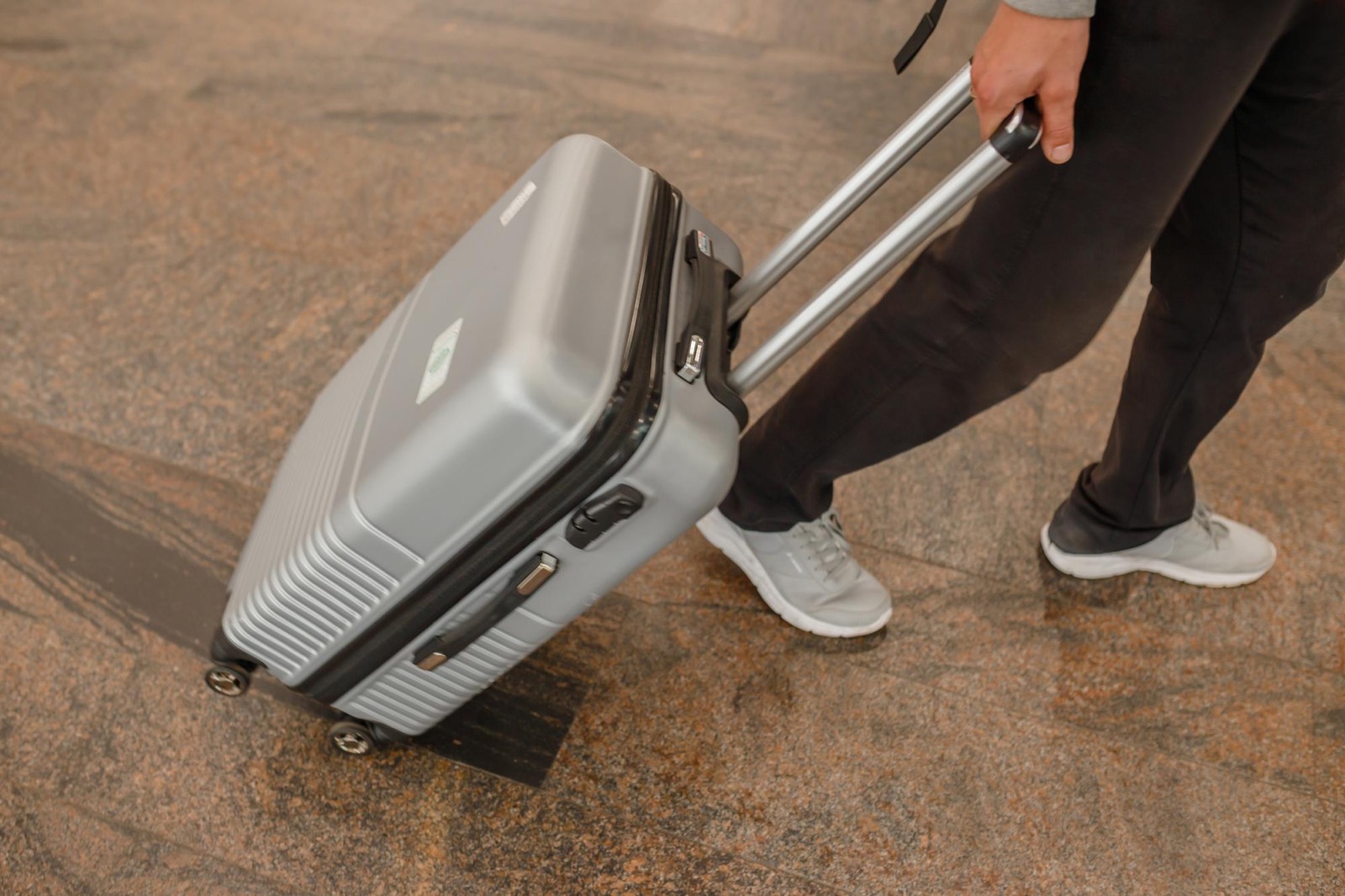
A four-wheel spinner glides upright beside you, which is the whole appeal of the format.
What to Look For in Hardside Luggage Before Anything Else
If you only remember one principle, make it this: the shell material and the wheels are the two parts that fail first, so they deserve most of your attention. Handles, zippers, and interior straps matter, but a cracked shell or a sheared-off wheel is what turns a suitcase into trash.
There's a second, less obvious principle that the better sources keep repeating. Two suitcases can both advertise the same material and still perform very differently because of shell thickness, blended additives, hardware quality, and overall construction. Consumer Reports makes exactly this point in its hard-shell versus soft-shell guide: the base material is a starting signal, not a guarantee (Consumer Reports). So treat "polycarbonate" or "ABS" as the first filter, then look at the specifics underneath it.
The short checklist
Before we go deep on each topic, here's the quick version you can carry into a store or a product page:
- Shell material — polycarbonate for durability, polypropylene for the lowest weight, ABS for the lowest price.
- Weight — check the empty weight of the carry-on; every pound of bag is a pound you can't pack.
- Wheels — smooth-rolling 360-degree spinners, ideally recessed or reinforced at the corners.
- Lock — an integrated TSA-recognized combination lock, not an aftermarket padlock.
- Dimensions — the carry-on must measure 22 x 14 x 9 inches or smaller, wheels and handle included.
- Expansion — a zippered expansion gusset adds packing flexibility on the way home.
- Warranty — a long limited warranty is both protection and a signal of the maker's confidence.
Everything below is just these seven points, explained well enough that you can tell a real difference from a marketing one.
Polycarbonate vs ABS Luggage: The Material That Decides Durability
Hardside shells come in three common plastics, and the trade-offs between them are the single most consequential choice in the whole purchase.
Polycarbonate
Polycarbonate is the material most premium hardside luggage uses, and for good reason. According to Travelpro's shell-materials guide, polycarbonate is "strong and durable" and "crack, scratch, and impact resistant," with the best overall balance of toughness and weight, though it sits at a moderate price point above polypropylene (Travelpro). The behavior that matters in the field is its flex: when a polycarbonate case takes a hard hit, the shell deforms momentarily and springs back to shape rather than holding a dent or splitting. Consumer Reports describes the same property when it explains that polycarbonate is more durable than ABS even though ABS can be lighter (Consumer Reports).
ABS
ABS (acrylonitrile butadiene styrene) is the budget hardside material. It's rigid and inexpensive, which is why it shows up so often on value-priced sets, but its rigidity is also its weakness. Travelpro notes ABS is the heaviest of the hard-side materials, is vulnerable to high temperatures, and that its components may break under stress (Travelpro). Where polycarbonate flexes and recovers, ABS is more likely to dent permanently or crack at the stress point. That doesn't make it a bad buy — for a few trips a year and gentle handling it's perfectly serviceable — it just means you're trading long-term resilience for a lower sticker price.
Polypropylene
Polypropylene is the lightweight specialist. Travelpro calls it the lightest hard-side luggage material and notes it's crack-resistant, with the main caveats being that it's less rigid than polycarbonate and prone to color fading from UV exposure over time (Travelpro). If shaving every possible pound is your priority and you don't mind a slightly more flexible shell, polypropylene earns a look.
How to decide
Match the material to how you travel. If you check bags often, fly internationally, or simply want the set to last for years of rough handling, polycarbonate is the safe default. If you take a couple of light trips a year and price is the deciding factor, ABS will do the job. If weight is your obsession and you fly carriers with strict allowances, polypropylene is the lightweight play. The budget-friendly Kenneth Cole Reaction set we cover in our Kenneth Cole Reaction Out of Bounds review is a good case study in how a value hardshell set positions itself against pricier polycarbonate options.
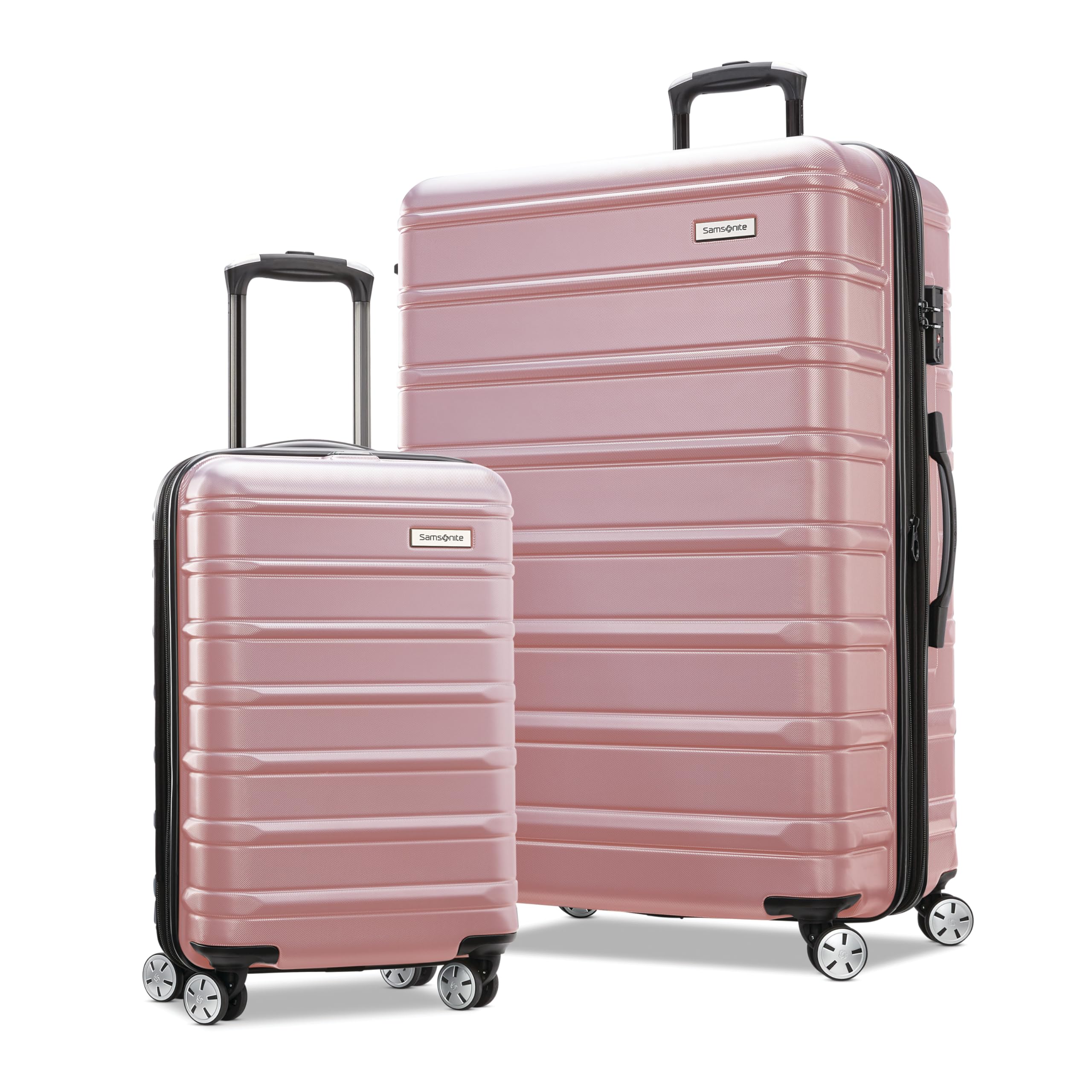
The Samsonite Omni 2 uses a 100% polycarbonate shell with a micro-diamond texture that hides scuffs.
What Makes Good Spinner Wheels (and Why They Fail)
Spinner wheels are the defining feature of the format. Unlike a two-wheel rollaboard that you tilt and drag, a four-wheel spinner stands upright and pivots a full 360 degrees, so it glides beside you down a concourse instead of pulling on your wrist. That convenience is also the format's Achilles' heel, because those wheels protrude from the corners and take the brunt of every drop.
Single vs dual wheels
You'll see two configurations: four single wheels (one per corner) or eight dual wheels (a pair per corner). Neither is universally better. With dual wheels, the load is shared across more contact points, so each wheel does less work and the bag tends to feel stable; some manufacturers double up specifically for that durability and stability benefit. The flip side is that the individual wheels are smaller, and more protruding parts means slightly more chance of one snagging during rough handling. A well-made single wheel, by contrast, is often larger with a broader tread and can be built from higher-grade material, which is why several premium brands stick with one solid wheel per corner. The recurring expert takeaway is that wheel quality matters more than wheel count (Expert World Travel).
What to actually check
Roll the bag if you can. Good spinner wheels turn freely with a light push and don't chatter or wobble. On a product page, look for wording about reinforced, recessed, or "re-engineered" wheels — the Samsonite Omni line, for instance, advertises re-engineered lightweight spinner wheels for smoother mobility (Samsonite). Corners that tuck the wheels in slightly, or that armor them, survive carousel abuse better than wheels that jut straight out. And before you buy, confirm the brand sells replacement wheels; a suitcase with a great shell and unobtainable wheels is a one-strike product.
One more wheel detail worth knowing: the surface you'll actually use the bag on changes which design wins. Spinners are at their best on smooth airport floors and hotel lobbies, where rolling a fully loaded bag upright beside you costs almost no effort. On cobblestones, gravel, or curbs, those same recessed corner wheels can struggle, and a larger, more rugged two-wheel inline design sometimes handles broken ground better. If your trips routinely involve old-city streets or train platforms, weigh that trade-off rather than assuming a spinner is automatically superior (Expert World Travel).
TSA Lock Luggage Explained
A "TSA lock" is a combination lock built to a standard that lets U.S. Transportation Security Administration officers open and re-lock your bag with a master key during an inspection, without cutting the lock off. The practical payoff is simple: you can lock your suitcase, and if it gets pulled for a manual check, the agent opens it, inspects it, and re-secures it instead of leaving your zippers gaping or destroying a padlock.
When you're comparing sets, prefer an integrated TSA lock — one molded into the shell, like the integrated TSA lock on the Samsonite Omni 2 — over a separate padlock you thread through the zipper pulls. Integrated locks can't be left at home, can't dangle and snag, and are tied directly into the zipper tracks. It's a small feature with outsized convenience, especially on checked bags. Keep your expectations calibrated, though: a TSA lock deters casual tampering and keeps zippers closed in transit. It is not a vault, and zipper-pull locks in general can be bypassed by a determined thief. Think of it as the luggage equivalent of a screen door lock — useful, standard, and not a substitute for not packing valuables in checked baggage.
Best Size Luggage Set to Buy: Reading the Dimensions That Matter
Sizing is where a lot of buyers get tripped up, because a set's "20-inch" or "28-inch" label is a rough nickname, not the number the airline measures.
The carry-on rule you can't ignore
Most major U.S. airlines cap carry-on bags at 22 x 14 x 9 inches, including wheels and handles. Delta states it plainly: individual length, width, and height "may not exceed 22" x 14" x 9" (56 cm x 35 cm x 23 cm)" with a combined limit of 45 linear inches (Delta Air Lines). The whole industry is converging on that 22 x 14 x 9 standard, with Southwest a notable outlier at a slightly larger 24 x 16 x 10 inches (SmarterTravel). The trap is that airlines measure total exterior dimensions — from the bottom of the wheels to the top of the retracted handle, including any protruding parts. A bag marketed as a carry-on whose true overall height is 23 inches can be gate-checked. Always look for the overall dimensions on the spec sheet, not just the body or packing dimensions, and compare those against 22 x 14 x 9.
Checked sizes and linear inches
For checked bags, airlines use a 62-linear-inch limit (length plus width plus height combined) before oversize fees kick in. A 28-inch checked case typically lands comfortably under that, while the largest 30- and 32-inch cases can flirt with the line once you add wheels — so if your set includes a big checked piece, add up its three overall dimensions and confirm the total stays under 62 inches for your airline.
Expandable shells
Many hardside sets include a zippered expansion gusset that adds an inch or two of depth. It's genuinely useful on the return leg when you're packing souvenirs, but remember it pushes a borderline carry-on over the legal limit when expanded. Use the expansion for checked bags, and keep your carry-on zipped to its base size for the cabin.
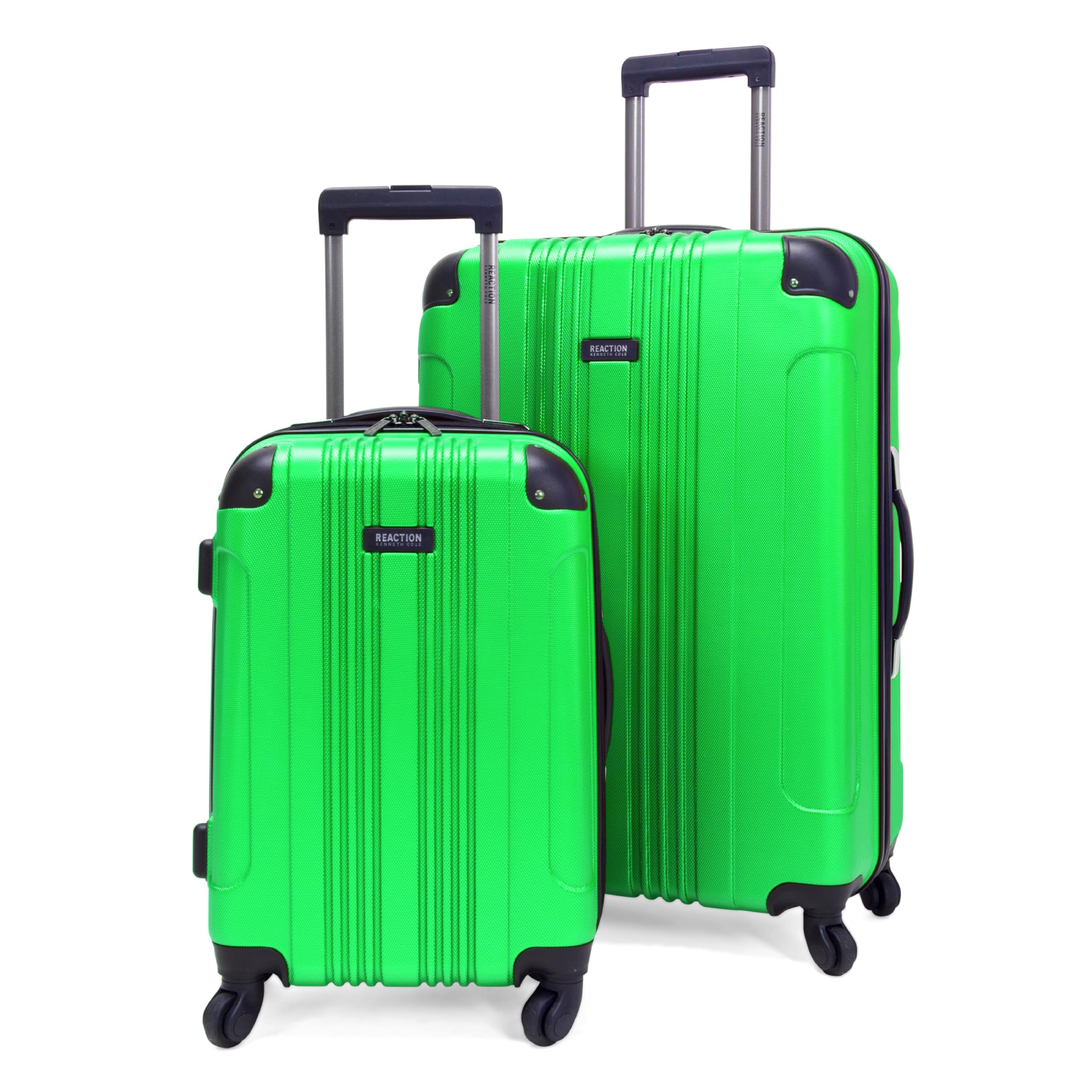
A two-piece set pairs a carry-on with one checked bag, the most common configuration for couples and solo travelers.
How Many Pieces in a Luggage Set Do You Need?
Sets usually come as two pieces (a carry-on plus one checked bag) or three pieces (a carry-on plus a medium and a large checked bag). Bigger is not automatically better — the right count depends on who's traveling and how.
Two-piece sets
A two-piece set, typically a 20-inch or 21-inch carry-on paired with a 28-inch checked bag, is the sweet spot for most people. A solo traveler can take the carry-on for short trips and check the large bag for longer ones, and a couple can share both for a week away. You aren't storing a checked piece you rarely use, and you spend less. The Kenneth Cole Reaction two-piece set we examine in our budget hardside set review is built around exactly this carry-on-plus-checked pairing.
Three-piece sets
A three-piece set adds a mid-size (usually 24-inch or 25-inch) checked bag in between. It earns its keep for families, frequent travelers who want to right-size the bag to the trip, and anyone who values nesting all three pieces together for compact storage. The downside is cost and the reality that the medium bag often gathers dust.
How to decide
Count your typical trips, not your aspirational ones. If most journeys are a long weekend plus the occasional two-week haul, two pieces cover you. If you have a household that travels together or you genuinely flex between trip lengths, the third bag pays off. Either way, prioritize the quality of the carry-on, since it's the piece you'll reach for most often.
How to Choose Luggage for International Travel
International trips raise the stakes on a few of the criteria above, so it's worth a focused look if that's your use case.
First, weight matters more abroad. Many international and budget European carriers enforce stricter weight allowances than U.S. domestic flights and weigh bags at the gate, so the empty weight of the suitcase eats directly into your allowance. This is where polycarbonate's good strength-to-weight ratio, or an outright polypropylene shell, pays off (Travelpro).
Second, size standards vary. The 22 x 14 x 9 carry-on norm is common in the U.S., but plenty of international carriers use smaller cabin allowances. Check the specific airlines on your itinerary rather than assuming the domestic standard travels with you (SmarterTravel).
Third, durability and serviceability climb the priority list. More connections and more handling mean more chances for a wheel to snag or a shell to take a hit, so favor a tougher polycarbonate shell, solid wheels, and a brand whose parts and warranty service you can actually reach. A long warranty is reassuring precisely because international travel is harder on luggage.
Don't Overlook the Handle and the Interior
The shell and wheels deserve top billing, but two more parts quietly shape the daily experience of using a hardside set.
The telescoping handle is the component your hand touches most, and a cheap one announces itself fast. Better handles lock firmly at multiple heights without rattling, retract smoothly, and use a thicker tube that doesn't flex when you steer a heavy bag through a turn. A handle that wobbles or sticks on its first trip rarely improves with age, and on most suitcases it's not a part you can easily replace, so it's worth testing in the store. A multi-height telescoping handle is one of the markers reputable guides flag as a sign of solid hardside construction (CNN Underscored).
The interior matters more on a hardside than you'd expect, because the rigid clamshell splits into two equal halves rather than one deep main compartment plus a lid. That split means you're effectively packing two shallower spaces, so look for a full zippered divider on at least one side, compression straps to keep clothes from shifting, and mesh pockets for small items. A well-organized interior is the difference between a hardshell that packs cleanly and one where everything slides into a heap the moment you open it on a hotel bed.
The Warranty Is a Spec, Not a Footnote
It's easy to skim past the warranty line, but it's one of the more honest signals a manufacturer sends. A maker willing to back a hardside set with a long limited warranty is telling you it expects the bag to survive years of use. Samsonite, for example, covers the Omni line with a 10-year limited warranty against defects in materials and workmanship (Samsonite warranty). Budget sets typically offer shorter coverage, which is part of what you're trading away for the lower price.
Read the fine print for two things. First, most luggage warranties cover manufacturing defects, not airline-inflicted damage — that's a claim you file with the carrier, not the brand. Second, longer warranties are easiest to honor when the brand has an established service and parts network, which loops back to why serviceability matters. A 10-year warranty from a maker that stocks replacement wheels is worth more than an identical promise from a brand you can't reach.
A Quick Worked Example: Reading Two Real Sets
To make the checklist concrete, it helps to see how the criteria sort two actual products.
On the premium end, a set like the Samsonite Omni 2 leans on a 100% polycarbonate shell with a scratch-resistant micro-diamond texture, integrated TSA lock, expandable shells across the sizes, re-engineered spinner wheels, and that 10-year limited warranty (Samsonite). Spec sheets for the carry-on list an empty weight in the range of roughly 6.8 to 7.5 pounds depending on the configuration, which is competitive for a polycarbonate hardside (Luggage Factory). That's the profile of a set built for frequent flyers and checked-bag abuse.
On the value end, a lightweight hardshell set such as the Kenneth Cole Reaction Out of Bounds pairs a 20-inch carry-on with a 28-inch checked bag, four-wheel spinners, and a lower price, accepting a shorter warranty and a value-grade shell as the trade-off. Neither is "the right answer" in the abstract — they're optimized for different buyers. The point of the checklist is to know which trade-offs you're accepting.
For the full picture of how several of these sets stack up against each other across material, weight, wheels, and price, our pillar guide to the best hardside spinner luggage sets lays them side by side.
Putting It All Together: Your Decision Sequence
Here's the order we'd run the decision in, fastest filters first:
- Fix your budget and material tier. Polycarbonate if durability and longevity lead; ABS if price leads; polypropylene if weight leads.
- Confirm the carry-on's overall dimensions are 22 x 14 x 9 inches or smaller, wheels and handle included (Delta Air Lines).
- Check the empty weight of the carry-on, especially for international itineraries with strict allowances.
- Inspect the wheels — smooth 360-degree roll, reinforced or recessed corners, replaceable parts.
- Require an integrated TSA lock rather than a separate padlock.
- Decide two pieces or three based on your real trip mix, prioritizing carry-on quality.
- Read the warranty as a confidence signal and confirm the brand has reachable service.
Run a candidate set through those seven steps and the marketing adjectives fall away, leaving you with the handful of facts that actually predict how the bag will hold up. That's the whole job of learning how to choose a hardside spinner luggage set: turning a wall of look-alike suitcases into a short, honest comparison you can act on.
Related Posts