

How to Choose a Cordless Battery Lawn Mower Without Overpaying
Walk into any home-improvement store today and the gas mowers are quietly retreating to a back corner while the battery models take the front aisle. That shift is real, and it is happening fast. But "battery powered" is not a single product category any more than "car" is. A 20-volt mower built for a courtyard lawn and an 80-volt self-propelled machine built for three-quarters of an acre share a name and almost nothing else.
Knowing how to choose a cordless battery lawn mower comes down to matching four variables to your specific yard: voltage, battery capacity, deck width, and drive type. Get those right and the mower disappears into the background of a Saturday morning. Get them wrong and you are either coiling an extension cord of frustration around a machine that dies halfway through the lawn, or you have spent an extra few hundred dollars on torque you will never use.
This guide walks through each decision the way a careful buyer should, grounded in manufacturer specifications and independent lab testing rather than guesswork. A quick note on method: our assessments cross-reference three independent evidence layers — manufacturer spec sheets, professional lab and expert reviews, and recurring themes in verified owner feedback — so each pick reflects how a mower performs across many yards, not a single afternoon. Everything below is synthesized from manufacturer spec sheets and reputable third-party sources such as Consumer Reports, whose lab plants 1,800 pounds of grass seed and cuts roughly 500,000 square feet a year to rate these machines. Where we cite a spec, we link the primary source so you can verify it yourself.
Start With Your Yard, Not the Mower
The single most common mistake is shopping for a mower before measuring the lawn. Every other decision flows from yard size, slope, and grass type, so that is where the process has to begin.
Pace off your lawn or pull up a satellite measurement tool and get a rough square-footage figure. As a working rule, Consumer Reports notes that the average battery mower in its tests runs 45 to 50 minutes per charge, which "could easily handle a quarter acre, even on somewhat sloped land," per its battery mower testing. A quarter acre is about 10,000 square feet, so that runtime figure is a useful anchor: if your lawn is meaningfully larger, you need either more battery capacity, a second battery, or a higher-voltage platform.
Slope matters as much as size. A flat 8,000-square-foot lawn is far less demanding than a 6,000-square-foot lawn with a couple of inclines, because climbing draws more current and drains the pack faster. Thick, fast-growing grass (think St. Augustine or a neglected first cut of the season) also pulls more power than a tidy, frequently mowed fescue. When in doubt, size up on battery capacity rather than down.
Finally, look at obstacles. A lawn carved up by flower beds, trees, and tight gates rewards a narrower, more maneuverable deck, while a wide-open rectangle rewards the widest deck you can push. Mapping your yard honestly here saves you from buying either too much mower or too little.
Decode the Voltage Numbers
Voltage is the spec manufacturers put in the largest font, and it is the spec most often misunderstood. Higher voltage generally means more available power and torque, which translates to a motor that can spin a blade through dense grass without bogging down. Residential cordless mowers cluster into a few tiers, and a helpful buyer's-guide breakdown from a retailer reference lines up roughly like this:
- 20V to 40V suits small, flat lawns up to about a quarter acre. These mowers are light, easy to store, and budget-friendly, but they trade away torque and runtime.
- 40V is the residential sweet spot in the United States, with enough power for a quarter-acre to half-acre lawn of typical grass density.
- 60V and 80V are built for larger or tougher yards, delivering the torque to chew through thick grass and the runtime to keep going on bigger plots.
Here is the part the marketing rarely emphasizes: voltage alone does not determine how long you can mow. Voltage governs power; capacity governs endurance. A 60V mower with a small battery can run out before a 40V mower with a large one. So treat voltage as a measure of muscle, not stamina, and read it alongside the amp-hour rating every time.
One practical footnote on platforms. Battery brands are walled gardens. A Greenworks 60V pack will not fit an EGO 56V mower, and vice versa. If you already own cordless yard tools, staying within that battery family lets you share packs across a trimmer, blower, and mower, which is a genuine cost saving. Greenworks, for instance, notes that its 60V battery powers more than 75 tools on the same platform, according to its official 60V product page.
Amp-Hours: The Number That Actually Sets Runtime
If voltage is muscle, amp-hours (Ah) are the fuel tank. Battery capacity, measured in amp-hours, is the figure that most directly controls how long the mower runs on a charge. Cordless mowers typically ship with packs between 2.0Ah and 6.0Ah, and a higher number means more runtime, as the retailer buying guide lays out.
The practical translation: most quality cordless mowers deliver 30 to 60 minutes per charge depending on voltage, capacity, and grass thickness, which covers roughly 5,000 to 10,000 square feet. Consumer Reports puts the average a bit higher at 45 to 50 minutes, with the best performers running 70 minutes or more.
A few things to watch when you read the capacity spec:
- Look for dual-battery designs on larger mowers. The Greenworks 60V 21-inch self-propelled model runs two 4.0Ah packs with auto-switchover, which the manufacturer rates at 60-plus minutes of continuous mowing covering up to three-quarters of an acre, per its spec page. Two packs also mean you can keep one charging while the other works.
- Check charge time, not just runtime. A "rapid charger" that refills a pack in under an hour changes the calculus for a big lawn. If a single charge will not finish your yard, a fast charger plus a spare battery effectively gives you unlimited runtime.
- Cold and heat shorten capacity. Lithium packs deliver less in very cold weather, so a battery that is comfortable in spring may feel marginal on a chilly first cut.
When you are unsure how much capacity you need, the cheaper insurance is buying a mower that accepts a second battery rather than the absolute largest single pack.
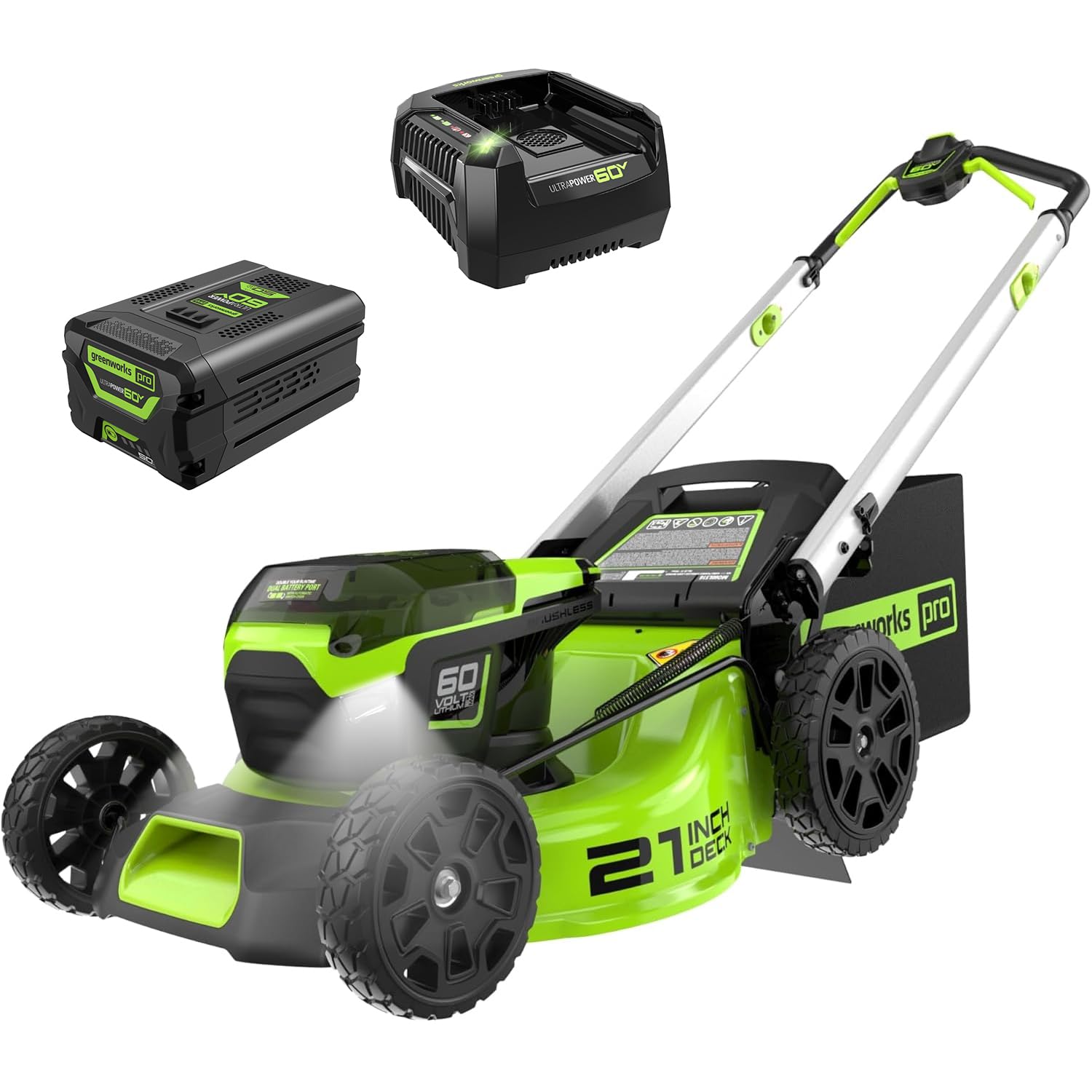
A single-battery push model, like this 5.0Ah Greenworks, keeps the price down while still handling up to a half-acre lawn.
Match Deck Width to Maneuverability
The cutting deck is the metal housing around the blade, and its width sets how much grass you clear on each pass. Wider is faster on open ground, narrower is nimbler around obstacles, so deck size is a maneuverability decision as much as a speed one.
Industry guidance lines up cleanly here. For lawns under about 3,000 square feet with tight landscaping, a 17-inch or 19-inch deck is easier to thread between beds and around trees. The 21-inch deck, the most common size on mid-to-large residential mowers, shines on open lawns from a quarter acre and up, where its extra width simply means fewer passes. That breakdown comes from a tool-review buyer's guide that tracks residential mowers across deck sizes.
Two trade-offs to keep in mind. A wider deck cuts faster but is heavier and harder to turn, which you feel acutely on a lawn full of corners. And a wider deck draws more power per pass, so on a battery mower it can shorten runtime slightly compared with a narrower deck on the same platform. For most quarter-acre-and-up suburban lawns the 21-inch deck is the right default; reach for 17 to 19 inches only when storage space is tight or the yard is genuinely small and cluttered.
Do not overlook cut-height adjustment while you are looking at the deck. A good mower offers single-point height adjustment across a useful range. The Greenworks 60V 21-inch model, for example, offers seven positions from 1.38 to 4 inches on a single lever, according to its product specifications, which lets you raise the cut in summer heat and drop it for a tidy final pass without fighting four separate wheel adjusters.
Push or Self-Propelled?
Self-propelled mowers drive their own wheels so you steer rather than shove. Push mowers rely entirely on your legs. The right choice depends on your yard's size, slope, and your own comfort doing the walking.
For small, flat lawns, a push mower is usually the smarter buy. It is lighter, simpler, cheaper, and there is nothing to drive a transmission, so there is one less system to maintain or break. A self-propelled mower carries its own weight willingly, but on a tiny flat lawn that drive system is dead weight and added cost.
The calculus flips as the yard grows or tilts. On a half-acre lawn, or any lawn with meaningful slopes, self-propelled drive turns a chore into a walk. It also tends to pair with the larger, heavier decks and dual-battery setups that big lawns demand, where shoving a 70-pound machine uphill would be genuinely tiring. The trade-off is price and weight: self-propelled models cost more and are heavier to lift into a truck or hang on a garage wall.
A useful real-world comparison sits inside the Greenworks 60V 21-inch line itself, which offers the same deck in both forms. The push version runs a single 5.0Ah battery to keep cost and weight down, while the self-propelled version adds drive and a second battery for bigger plots. If you want to see how the premium, feature-rich configuration handles a buying-criteria walkthrough end to end, our Greenworks 60V 21-inch self-propelled review goes through it spec by spec.
Brushless Motors and the Specs That Quietly Matter
Beyond the headline numbers, a handful of secondary specs separate a mower you will be happy with from one you will quietly resent.
Brushless motor. Most quality cordless mowers now use a brushless motor, and it is worth insisting on. Brushless designs run more efficiently, generate less heat, last longer, and deliver steadier power as the battery drains. Greenworks describes its brushless motor as providing "constant, fade-free power" and rates the 60V 21-inch unit at 3,200 RPM, equivalent to a 150cc gas engine, on its product page. That efficiency is also part of why battery mowers can match gas on cut quality.
Mulching and discharge options. A 4-in-1 deck that can mulch, bag, side-discharge, and handle leaf pickup gives you flexibility through the seasons. Mulching is the eco-friendly default for routine mowing because it returns clippings as fertilizer, and Consumer Reports notes that battery and gas walk-behind mowers are "about even" at mulching, scoring each on how fine the clippings are and how evenly they spread without clumping, per its mulching test guide.
Weather resistance and conveniences. An IPX4 rating means the mower tolerates splashing and damp grass, which matters more than buyers expect. LED headlights extend mowing into early mornings and evenings, and an onboard runtime display takes the guesswork out of whether you will finish the lawn before the battery quits. These are not gimmicks on a machine you will use weekly for years.
Weight and storage. Battery mowers fold for vertical storage in a way gas mowers cannot, and many stand on end to reclaim garage floor. If storage space is your real constraint, weigh that as seriously as deck width.
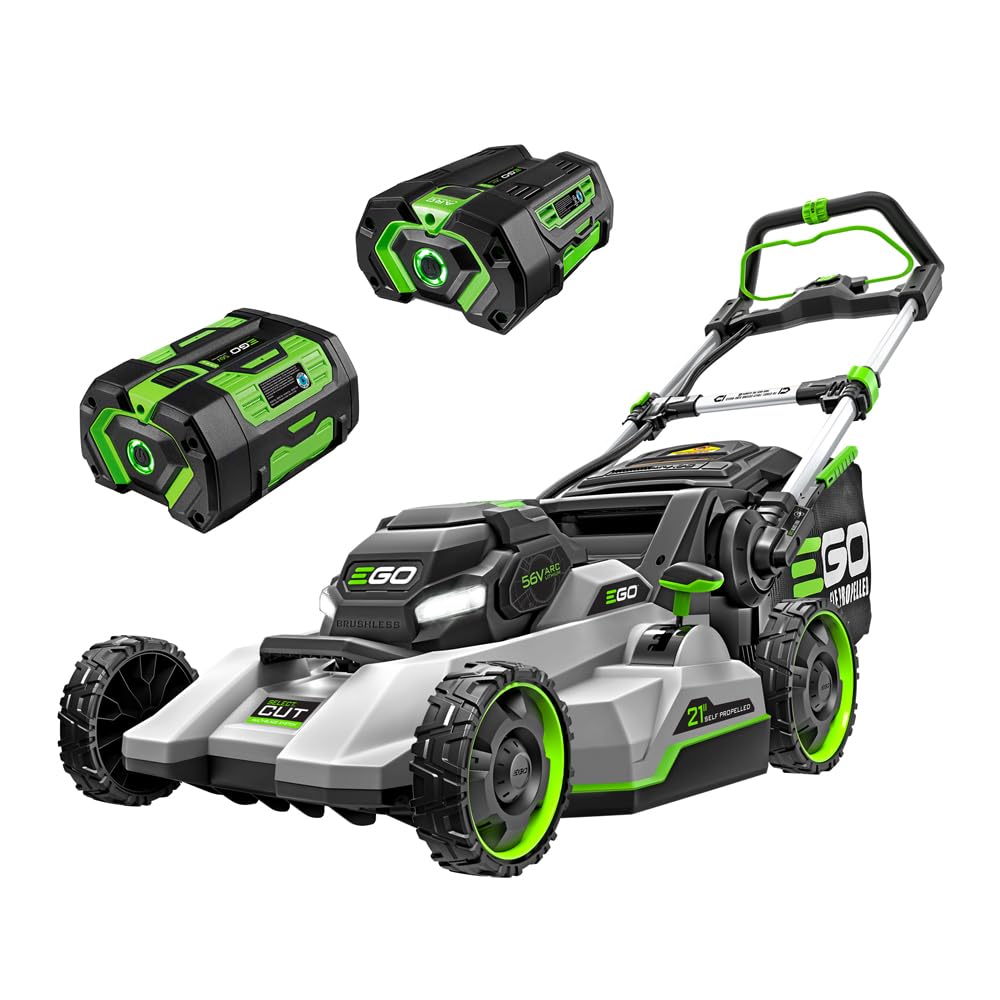
Competing platforms like EGO's 56V self-propelled mower show how brushless motors and rapid chargers have become table stakes across the category.
Budgeting Realistically
Residential battery mowers start around $350 including a battery and charger and climb past $1,000 for large self-propelled models with multiple high-capacity packs, with sale prices occasionally dipping near $300, according to the retailer buying guide. Where you land depends almost entirely on the yard you mapped at the start.
A few budgeting principles keep you from overspending or underbuying:
- Buy the battery you need, not the biggest one sold. Capacity is the priciest single component. If a single 5.0Ah pack finishes your lawn with margin to spare, a dual-pack model is money spent on endurance you will not use.
- Factor in the spare-battery path. For a borderline-size lawn, a mid-tier mower plus a second battery often costs less than the next model up and gives you swap-and-keep-mowing flexibility.
- Price-check the bundle. A "cordless lawn mower with battery and charger" sold as a kit is almost always cheaper than buying a bare tool and adding a pack and charger separately. Confirm the listing includes both before you compare prices.
- Watch the platform, not just the mower. If you will eventually add a trimmer or blower, the long-run cost of staying on one battery family is lower than the sticker on any single tool suggests.
A reasonable starting point for many suburban buyers is a 40V or 60V mower with a 21-inch deck and at least a 4.0Ah pack, bought as a kit, with the option to add a second battery later. That configuration covers most quarter-acre-and-up lawns without paying for a riding mower's worth of capacity.
A Closer Look at Small Yards
If your lawn is genuinely small, the calculus simplifies, and it is worth treating separately because the "best battery powered lawn mower for a small yard" is rarely the one with the biggest spec sheet. On a courtyard, townhouse strip, or compact suburban lot under about a quarter acre, the constraints flip from endurance to convenience and storage.
For these lawns, a 20V to 40V push mower with a 17-inch to 19-inch deck usually hits the sweet spot. A single mid-capacity pack will finish the cut with margin, the lighter weight makes turning around flower beds effortless, and the narrower deck threads gates and tight corners that a 21-inch machine would clip. You also save on price: the smaller-platform mowers sit at the bottom of the range, and you are not paying for self-propelled drive you would never engage on flat ground a few dozen feet across.
The one trap to avoid on a small lawn is buying so little capacity that you cannot mow when the grass is wet or overgrown after a rainy stretch. Even on a tiny lawn, thick or damp grass roughly doubles the current draw, so a 2.0Ah pack that is comfortable on a dry, well-kept cut can struggle after a week of rain. Stepping up to a 4.0Ah pack on the same small mower is cheap insurance and rarely adds meaningful weight or cost. Storage is the other quiet factor: most small-yard owners are short on garage space, so a mower that folds flat or stands on end is worth prioritizing over an extra inch of deck.
Battery Care and Long-Term Cost
A cordless mower's real running cost is the battery, and how you treat it determines whether you replace a pack in three years or ten. Lithium-ion packs are consumable, but they are also forgiving when handled sensibly, and a few habits stretch their life considerably.
Heat is the enemy. Lithium cells degrade fastest when they sit hot, so the worst thing you can do is leave a battery baking on the deck in direct summer sun or store it in a sweltering shed. Keep packs indoors at moderate room temperature, and let a pack cool before charging it after a long, hot cut. For seasonal storage over winter, charging to roughly half rather than full and pulling the pack out of the mower is the gentle approach; a fully drained pack left for months is the scenario most likely to kill a battery outright.
Charging habits matter too. Lithium chemistry prefers shallow, partial cycles over repeated deep drains, so topping up before the pack hits empty is easier on the cells than running it to zero every time. Stick with the charger that came with the mower or a manufacturer-approved smart charger, since a matched charger manages voltage and temperature for that specific pack. Cleaning is simple: a dry cloth on the terminals and vents, never water, which is why the IPX4 rating protects the mower in damp grass but is not an invitation to hose down the battery.
Factoring battery replacement into your total cost is the honest way to compare models. A mower that runs an orphaned or proprietary pack with no affordable replacement is a worse long-term value than one on a widely sold platform, even if the sticker price is lower. This is the strongest practical argument for staying inside a popular battery family: years from now, a fresh pack will still be easy to buy.
Gas Versus Battery, Briefly
If you are still weighing the jump from gas, the short version is that the gap has closed. For walk-behind mowing on typical residential lawns, battery models now match gas on cut quality while eliminating oil changes, spark plugs, fuel storage, and pull-starts. Consumer Reports' gas-versus-battery comparison is the place to settle that debate in detail. The trade-off that remains is runtime on very large or steep properties, where gas still refuels instantly and a battery has to recharge, which is precisely why capacity planning matters so much on big lots.
Putting It All Together
Choosing a cordless battery lawn mower is really a sequence of four matched decisions. Measure the yard first. Pick a voltage tier that fits the lawn's size and grass density, treating voltage as power and amp-hours as runtime. Choose a deck width that balances speed against maneuverability for your obstacles. Then decide push versus self-propelled based on size and slope, and confirm the secondary specs, brushless motor, 4-in-1 deck, IPX4 rating, a sensible charge time, are all present.
Do that in order and you avoid both classic errors: the underpowered mower that dies mid-lawn, and the over-specced machine you paid a premium to barely use. For specific models that fit different yard profiles, our roundup of the best cordless battery lawn mowers for 2026 ranks the leading options against exactly these criteria, so you can move from "how to choose" straight to "which one."
Related Posts